English
 Français
 Deutsch
 Русский
 Türkçe
 Español
 لالعربية
 Português
 Italiano
 ไทย

What a Laser Cleaning Machine Costs to Buy and Run
release time:
2026-10-09
What drives laser cleaning machine price, what it costs to run each hour, and a payback model you can fill in with your own blasting or chemical stripping numbers.
Two quotes for what looks like the same laser cleaning machine can differ by a factor of three. Same wattage on the label, same housing, often the same colour. The difference sits in components you have to ask about by name, and in what is bolted to the machine beside it.
The other half of the question is running cost, and there the numbers are unusually friendly: no media, no chemicals, very few consumables, and an electricity bill you can verify with a clamp meter. This is what each side of the equation actually contains.
What Pushes the Price Up
Laser source. The single largest line. Raycus, Maxphotonics, JPT and IPG sources at the same rated power are not the same product, and the price spread between them is wide. Ask for brand and model in writing.
Average power against peak power. Some quotes advertise peak power. Cleaning performance follows average power, so a machine quoting 300 W peak with 200 W average is not a 300 W machine.
Cooling. Air-cooled heads cost more per watt and remove the chiller, the coolant and the floor space. Water-cooled units are cheaper to build and better suited to long duty cycles. For wide-area work that runs all shift, continuous laser cleaning matches the duty cycle better; pulsed heads suit thin sheet and delicate substrates. Neither is wrong; they suit different jobs.
Gun and optics. A light gun with a good protective window and a replaceable focal lens is worth more than it costs, because it is what your operator holds all day. Cheap guns eat lenses.
Fiber length and beam delivery. 5 m, 10 m, 15 m and 20 m options change both price and attenuation. Measure your largest part before ordering, not after the crate lands.
Automation. A cart, a gantry, a robot mount or an extraction trolley can add more to the invoice than the cleaning head itself.
Price Bands, and What Each Class Is For
Price follows coverage far more than any single number. These bands describe the shape of the hand-held market, and they move with source brand and configuration.
| Class | Typical coverage | What it cleans | Where it sits |
|---|---|---|---|
| 100 to 200 W | 1 to 2 m²/h | Oils, fingerprints, flash rust, heat tint | Entry level, light maintenance, moulds and tooling |
| 200 to 300 W | 1.5 to 2.5 m²/h | Surface rust, thin paint, weld prep | The volume seller for general fabrication |
| 500 W | 2 to 3.5 m²/h | Mill scale in one pass, thicker coatings | Heavier prep, larger workpieces |
| 1000 W | 3 to 5 m²/h | Powder coat, large moulds, ship sections | Industrial, usually gantry mounted |
| 1500 to 2000 W | 5 m²/h and up | Heavy scale, wide area stripping | Production lines, steel service centres |
Two machines inside the same band can still differ by half again, because within a class you are really choosing between a source with a service network in your region and one without.
Handheld, Cart or Gantry
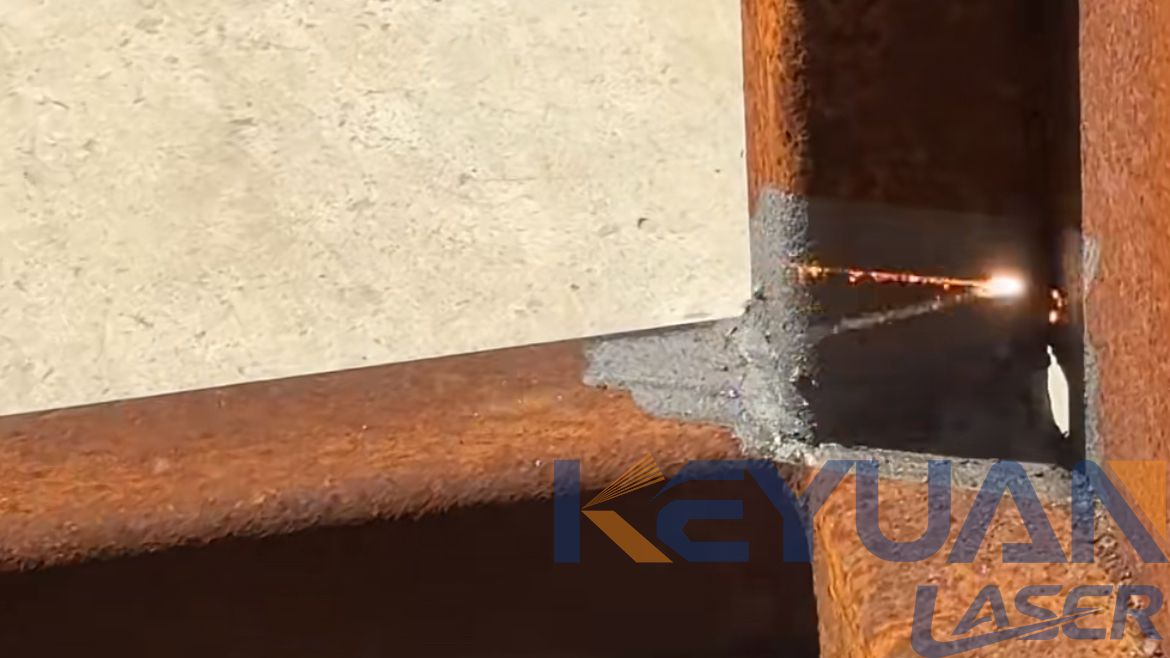
Handheld is the cheapest way to buy coverage, because you are not paying for the structure that moves the head. It suits welded frames, moulds, spools and anything else too large to carry to a table.
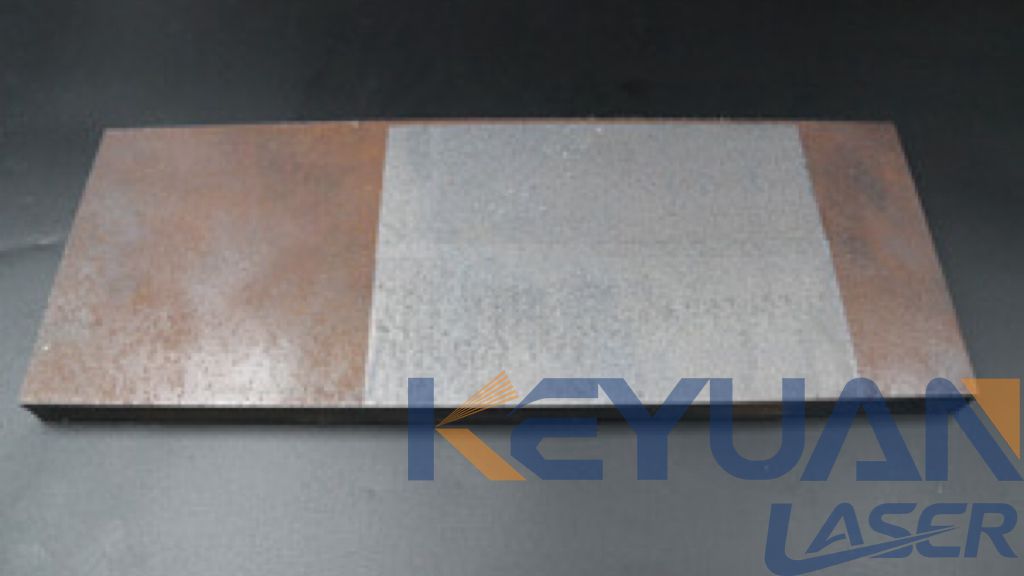
A cart-mounted unit adds a trolley and usually extraction, so the machine can work in a bay without a fixed extraction system. A gantry puts the head on a frame, and at that point the price stops being about the laser at all: the motion system, the enclosure and the interlocks take over.
The rule we use with buyers: if the part can come to the machine, do not pay for a handheld you then have to carry around. If it cannot, do not pay for a gantry you cannot move.
Running Cost Per Hour
This is the part buyers underestimate in the useful direction. A pulsed laser cleaning machine draws roughly 2 to 3 kW at the wall for a 300 W class head, chiller included.
| Cost line | 300 W class, per hour | Notes |
|---|---|---|
| Electricity | 0.50 to 0.75 EUR | 2 to 3 kW at 0.25 EUR/kWh |
| Protective window and lens | 0.10 to 0.30 EUR | A few changes a year, amortised |
| Chiller coolant and filter | negligible when amortised | Annual service |
| Blast media or chemicals | none | |
| Waste disposal | none beyond extracted fume | Filter changes |
| Operator | the dominant cost | Same as any other hand tool |
Set that against blasting, where the hourly rate quietly carries garnet, blast-suit PPE, compressor power and the disposal of spent media and paint sludge, or against chemical stripping, where the chemicals, tank time, rinse water and waste permits all have a price.
Across a shift, a laser is usually the cheaper process to run. It is not the cheaper process to buy, and that trade is the entire decision.
A Payback Model You Can Fill In
We deliberately publish no single payback figure, because it depends entirely on what the machine replaces. Build it from your own numbers in four steps.
Count the hours a month you spend cleaning, and how much of that is blasting, grinding or chemical stripping.
Price those hours: media or chemicals consumed, disposal, PPE, and labour at your own rate.
Estimate how much of that work a laser actually takes over. Be honest — it will not take salt contamination, and it will not take large flat areas from a blasting booth that already has the throughput.
Divide machine capital by the monthly saving.
| Machine capital | 1,000 EUR a month saved | 2,000 EUR a month saved | 4,000 EUR a month saved |
|---|---|---|---|
| 8,000 EUR | 8 months | 4 months | 2 months |
| 15,000 EUR | 15 months | 8 months | 4 months |
| 25,000 EUR | 25 months | 13 months | 6 months |
| 40,000 EUR | 40 months | 20 months | 10 months |
If the answer lands beyond three years, the machine is rarely the problem. The process substitution is too small. That normally means the work is large flat plate, which a blast booth does faster, or the cleaning hours are spread too thin across too many different jobs.
What a Quote Should Itemise
A quote that names only a wattage is impossible to compare against another. Ask for these lines separately, in writing.
Laser source brand, model, and whether the figure quoted is average or peak power.
Cooling method, plus the continuous duty rating at your ambient temperature.
Gun weight, protective window part number and price, focal lens price.
Fiber length, and whether spare lengths are available locally.
Extraction: whether it is included, and the filter class.
Eyewear, curtains or enclosure, and which party supplies them.
What is excluded: freight, duty, installation, training, spares kit.
Hidden Costs Worth Budgeting For
Extraction and filters. The process makes fine particulate. Nozzle extraction with a filter unit is part of the machine, not an accessory, and filters are a running cost.
Site power. A 1000 W class machine normally wants more than a single-phase socket. Check your supply before the crate lands, not after.
Spares. One spare protective window set and one focal lens on the shelf prevents a two-week stoppage over a part that costs less than a dinner.
Training. A day of proper training on parameters for your own materials is cheaper than a month of scrap.
Freight, duty and clearance. On export orders these add a real percentage to the quoted price, and they are almost always excluded.
Renting, Leasing and Buying Used
Used units turn up when a shop over-bought or the work moved on. Check the source hours, ask for the last service record, and insist on a test on your own material before money changes hands, because source and optics degradation does not show up in a photograph.
For occasional use, a few hours a month on moulds or weld prep, renting removes the capital question altogether, and the running cost argument still stands. Buy outright when the machine has steady work and you intend to keep it past the payback point.
FAQ
Why are two 300 W laser cleaning machines quoted so differently?
Almost always the laser source, then the gun, the cooling and the extraction. The same wattage on the label covers a wide range of real components. Ask for the source brand and model, and whether the power quoted is average or peak.
What does it cost to run per hour?
Roughly 0.50 to 0.75 EUR of electricity for a 300 W class machine running with its chiller, plus a few cents for the protective window amortised over its life. The operator is the largest line, exactly as with any hand tool.
Is a laser cleaning machine cheaper than sandblasting?
To run, usually yes once media, PPE and disposal are counted. To buy, no — a blast setup costs a fraction of a laser. The laser wins where weld prep, in-situ work and waste disposal are the constraints.
How long does the machine last?
Ten years is a sensible planning figure for the frame, chiller and motion parts. The laser source is the item with a finite hour count and is normally the first major replacement. Keep the extraction and chiller serviced and the optics clean and it will go the distance.
Do I have to buy the extraction with the machine?
Yes. Fine particulate from paint, scale and coatings is the process's main health risk, and nozzle extraction belongs in the purchase budget with the first set of filters. A handheld laser cleaning machine without extraction is a machine nobody should be standing next to.
The Short Version
The purchase price of a laser cleaning machine is dominated by the laser source, the cooling method and whatever you bolt to it. Running cost is small and predictable: electricity, a protective window, filters and the operator. Whether it pays back is decided by what you stop doing — media, chemicals, disposal and grinding hours — not by the wattage on the brochure.
label:
related news


E-mail address:
Hotline:
Copyright © 2012-2026 Keyuan Laser All rights reserved