English
 Français
 Deutsch
 Русский
 Türkçe
 Español
 لالعربية
 Português
 Italiano
 ไทย

Laser Welding Machine vs TIG and MIG: Where the Switch Pays
release time:
2026-10-09
Laser welding wins on speed, distortion and thin stainless, and loses on thick plate, poor fit-up and out-of-position work. Where the switch pays, with numbers.
A German sheet metal shop we quote regularly ran their own numbers last year and did not like the answer. Roughly 40% of their welding hours were going on 1.5 mm stainless enclosures with straight seams over 600 mm long, which is the exact shape of work a laser does quickly. They did not sell the TIG sets. They bought a laser welding machine, moved the enclosures onto it, and handed those TIG sets the jobs they are genuinely better at.
That is the honest shape of this comparison. Laser welding does not replace TIG or MIG. It takes a slice of the work, and that slice is defined by thickness, fit-up, seam length and how often you repeat the job.
This is what the slice looks like in numbers, and where the switch pays back.
What Each Process Is Actually Good At
TIG gives you control. You can feather an edge, walk a root pass around a tube, weld 0.8 mm sheet without blowing through, and adjust as the puddle moves. It is slow, it needs a real welder, and heat input is high.
MIG deposits metal fast. It tolerates gaps and dirty steel, runs thick sections economically and is the cheapest way to put filler into a joint. It also spatters, and on thin sheet it puts in enough heat to pull a panel out of square.
Laser welding melts a narrow keyhole with a fraction of that heat. Travel speed on sheet is several times faster, distortion is small enough to skip most straightening, and a cosmetic stainless bead often needs no post-weld grinding. The price of all of it is fit-up: the beam will not bridge a gap.
| Laser | TIG | MIG/MAG | |
|---|---|---|---|
| Heat input, 1.5 mm stainless | Low | High | Medium to high |
| Travel speed, 1 to 2 mm sheet | 1.2 to 2.0 m/min | 0.15 to 0.25 m/min | 0.4 to 0.7 m/min |
| Gap tolerance without filler | 0.1 to 0.2 mm; 0.3 to 0.5 mm with wobble | 0.5 to 1 mm with filler | 1 mm and up |
| Comfortable thickness | 0.5 to 4 mm single pass | 0.8 to 6 mm, any position | 3 mm and up |
| Distortion on thin sheet | Low | High | High |
| Post-weld cleanup | Often none on stainless | Brushing or pickling | Grinding and spatter removal |
| Skills needed | Days, it is a parameter job | Years | Weeks |
| Out-of-position work | Poor | Excellent | Good |
| Filler wire | Optional, 0.8 to 1.2 mm | Standard on most joints | Always |
Read that table as a map rather than a scoreboard. No row wins everywhere.
Where the Switch Pays
Long straight or gently curved seams in 0.5 to 3 mm material are where the money is.
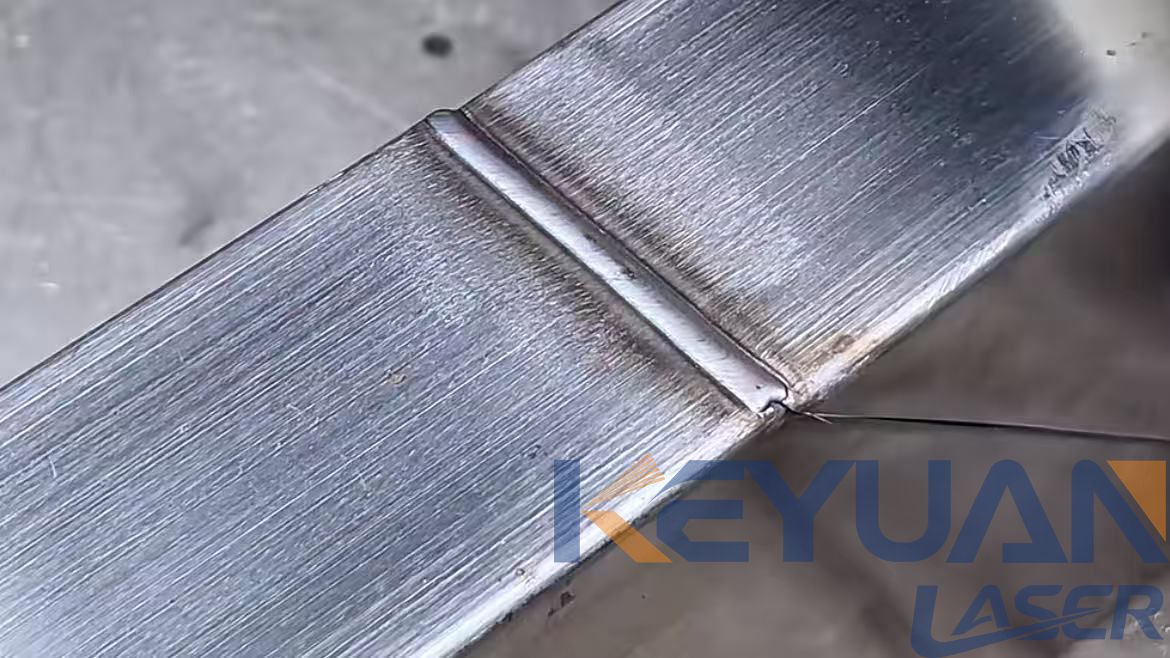
Speed is the easy argument. At 1.5 mm stainless, a 1500 W machine runs 1.2 to 2.0 m/min against 0.15 to 0.25 m/min for TIG. That is roughly a factor of eight on arc-on time, and it is not the whole saving, because TIG also carries tacking, cleaning and often a grind afterwards.
Distortion is the argument that closes the deal in shops that already own a straightening press. Low heat input means a 1.2 mm panel stays flat. Panels that stay flat do not have to be persuaded back, and the labour that disappears there is often larger than the welding labour itself.
Cosmetic stainless is the third. A well-set laser bead on 304 is uniform and largely oxide-free under argon, so welds that would have been brushed, pickled and brushed again come off the fixture finished.
Repetition is the multiplier. Laser welding rewards you for doing the same joint a thousand times, because the parameters that work are found once and saved as a program. A job shop welding a different assembly every afternoon never collects that return.
The Thickness Ceiling Nobody Mentions
Laser welding is a thin and medium sheet process. A 1500 W machine welds about 2 to 3 mm of stainless in one pass, and 2000 W buys 3 to 4 mm. Below 4 mm the comparison is unwinnable for TIG and MIG. Above 6 mm the arithmetic flips: MIG with 1.2 mm wire and sensible joint prep will out-deposit any handheld laser you can buy, at a fraction of the capital.
Multi-pass laser welding on 8 mm plate is technically possible and commercially pointless in most shops. If your work is structural steel, pressure pipe or 10 mm flanges, a laser is the wrong purchase and no configuration makes it right.
Fit-Up Is the Whole Game
An engineer with a shear and a press brake will hold plus or minus 0.3 mm on a bent panel. That is easy for TIG and comfortable for MIG. It is marginal for a fixed-spot laser head, which tolerates 0.1 to 0.2 mm before the beam drops through the gap and you get lack of fusion.
Two things fix it. A wobble gun sweeps the beam across the joint and widens the melt pool, which lifts practical gap tolerance to 0.3 to 0.5 mm. Filler wire, usually 0.8 to 1.0 mm, bridges what is left. Together they turn a laser from a process that demands perfect parts into one that tolerates ordinary fabrication.
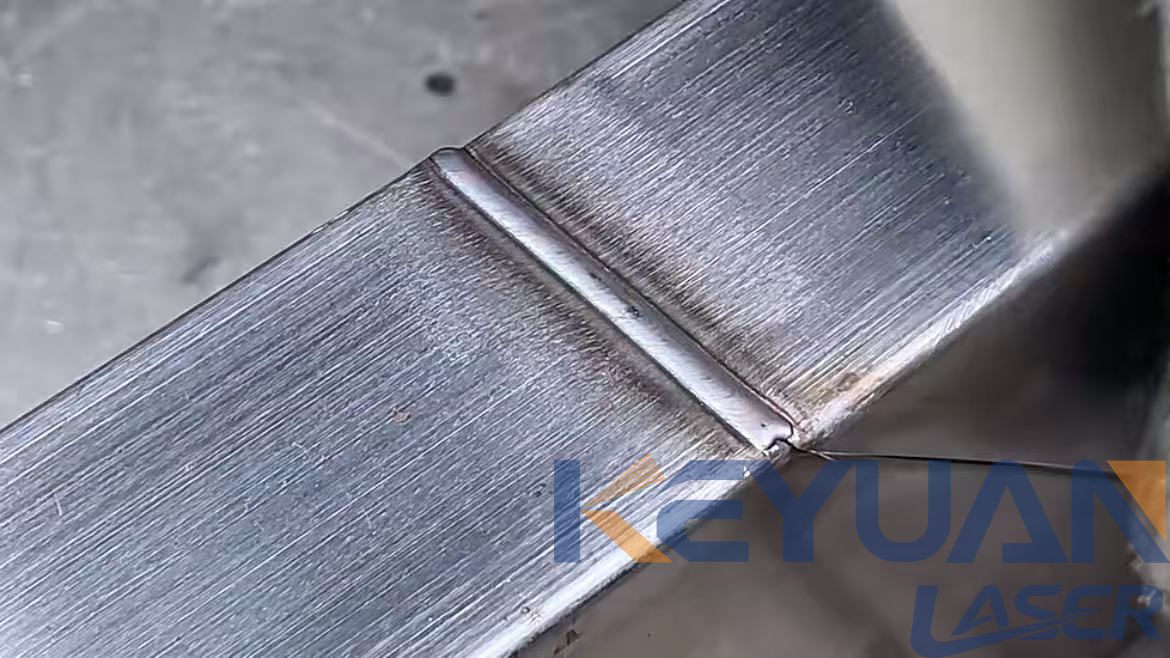
The blunt rule: if you cannot control the gap, do not buy a laser. Laser welding punishes poor fit-up with defects that look fine and fail later, and extra power does not compensate.
Consumables and What You Actually Spend
This is where laser welding looks expensive on paper and cheap in practice.
| Item | Laser | TIG | MIG/MAG |
|---|---|---|---|
| Filler metal | Optional, and less of it when used | Standard, 1 to 3 kg a shift on volume work | Highest consumption |
| Shielding gas | Argon or nitrogen, 15 to 25 L/min | Argon, 8 to 12 L/min | CO2 mix, 12 to 18 L/min |
| Nozzles, tips, liners | None | Collets, ceramics, tungsten | Contact tips, liners |
| Consumable that really costs money | Protective lens, plus chiller power | Tungsten, gas, grinding discs | Wire, gas, tips |
| Finishing consumables | Often none | Discs, brushes, pickling paste | Discs, spatter removal |
| Electrical draw | 3 to 8 kW at the wall, chiller included | 3 to 5 kW | 4 to 8 kW |
Run it on a real shop and the discs, brush wheels and pickling paste that stop being bought often cover the laser's lens and power bill on their own.
Operator Skill, and Why That Is the Real Cost
A good TIG welder is made over years and paid accordingly. A laser operator is trained over days, because the process is a parameter job: power, travel speed, focus position, wobble width, gas flow. Set them once for a joint, save the program, and the next operator repeats it.
That matters twice. It removes the dependency on one skilled person being present, and it lets you put welding onto lower-cost labour, or onto the same person who already runs the press brake. In shops where the TIG welder is also the schedule bottleneck, this is often worth more than the travel speed.
The flip side is diagnosis. When a laser weld fails there is nothing to feel. The operator reads the bead and works back through the parameters. Train on that deliberately, or you will own a fast machine that nobody trusts.
When to Keep the TIG and MIG Sets
Plate above 6 mm, structural work, pressure joints.
Tube and pipe root passes, and anything welded overhead or vertical.
Repair work on castings, where fit-up is whatever the crack left behind.
One-off fabrications with gaps you cannot close.
Very thin or very reflective material you have not proved the process on yet.
Work that leans on a welder's judgement rather than on a saved program.
Keeping both is normal. Most shops that buy a laser do not sell a welder; they change what each machine is used for.
Cost Per Metre, and How Payback Lands
Take a shop welding 1.5 mm stainless enclosures: 3 m of seam per unit, 200 units a month, so 600 m of weld.
| TIG | Laser | |
|---|---|---|
| Travel speed | 0.2 m/min | 1.5 m/min |
| Arc-on hours for 600 m | about 50 h | about 7 h |
| Tacking, cleaning, grinding | 15 to 20 h | 2 to 4 h |
| Welding labour a month | 65 to 70 h | 9 to 11 h |
| At 45 EUR an hour | 2,900 to 3,150 EUR | 400 to 500 EUR |
| Difference | 2,400 to 2,750 EUR a month |
Against that, a handheld laser welding machine with a wobble gun, a chiller and a spare lens set typically lands between 12,000 and 20,000 EUR depending on power, source brand and configuration. If the seam volume above is real, the machine pays for itself somewhere between five and nine months, before you count the straightening press time that stops being used and the finishing consumables that stop being bought.
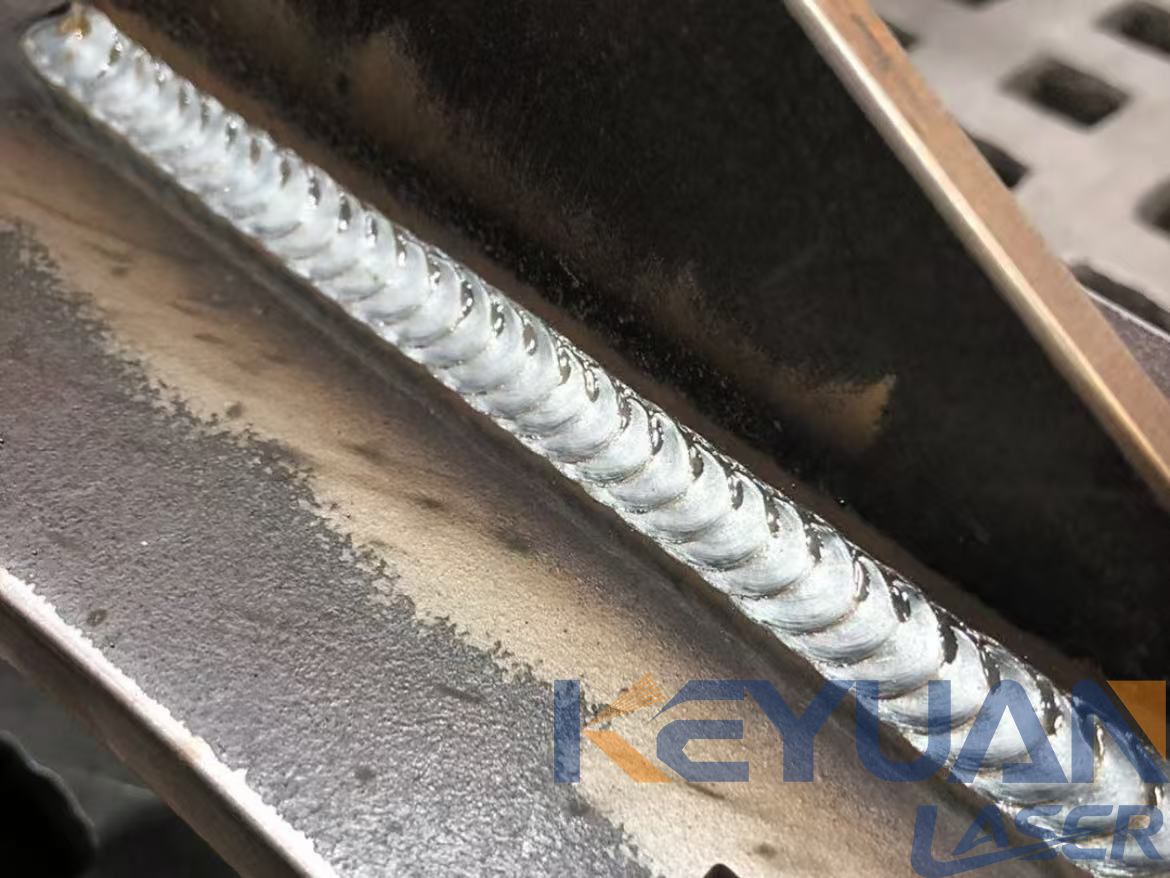
The calculation only works if the volume is real. Drop to 100 m of seam a month and the same machine takes two to three years to pay back, at which point the case rests on quality and on the welder you cannot hire rather than on hours saved.
For a fixed workstation rather than walking the machine to the part, a multi-function laser welder covers welding, cutting and cleaning from one head, which helps when cleaning before welding is part of the same job. In a production cell running steady duty cycles, water-cooled laser welding holds its output through an eight-hour shift better than an air-cooled unit, which matters when part fifty has to match part one.
Where the parts cannot come to the bench, look at air-cooled laser welding and the nitrogen generator laser welder, which take the chiller and the gas bottle out of the van. On-site work is covered in more detail in our note on on-site metal repair, and thin sheet work in the thin stainless cabinet seam welding case.
FAQ
Can a laser welding machine replace TIG completely?
No. It replaces a slice: thin to medium sheet, repeatable joints, good fit-up, flat or horizontal position. Thick plate, pipe roots, repair work and out-of-position joints stay with TIG and MIG.
Is a laser weld stronger than a TIG weld?
Not by default. A laser keyhole gives deep, narrow penetration, which on equal thickness often beats TIG, but the margin disappears the moment fit-up is poor and you get lack of fusion. Strength follows the procedure and the fit-up, not the heat source.
Do I still need filler wire?
On a tight square butt joint in 1.5 mm sheet, no. Once you are bridging a gap, welding thicker sections or welding aluminium, wire helps. Most handheld systems accept 0.8 to 1.2 mm wire, and the wobble gun plus wire feed is what makes the process practical in a real fabrication shop.
Does laser welding need a safety enclosure?
Yes. It is a Class 4 laser. Fixed installations belong in an interlocked enclosure, and handheld work needs a screened cell or laser curtains, plus eyewear rated for the wavelength, with reflections in mind. Extraction at the nozzle is needed for fume and metal vapour.
Do I still have to clean the joint?
Yes. Oil, oxide and mill scale all change how the beam couples into the metal, and contamination is one of the more common causes of porosity. Where parts arrive rusty, a pulsed laser cleaning machine takes the oxide off in the same cell, without abrasives or solvents.
The Short Version
Laser welding takes thin to medium sheet, long repeatable seams and cosmetic stainless away from TIG and MIG, with far less distortion and little or no grinding. It loses on thick plate, poor fit-up and out-of-position work, and it depends on your parts being consistent. Buy it for a defined slice of the work, keep the TIG sets, and payback lands inside a year on real volume.
label:
related news


E-mail address:
Hotline:
Copyright © 2012-2026 Keyuan Laser All rights reserved