English
 Français
 Deutsch
 Русский
 Türkçe
 Español
 لالعربية
 Português
 Italiano
 ไทย

Laser Welding Production Line Integration: When a Cell Pays
release time:
2026-10-19
Putting a laser welder into a production line: cycle time, loading, robot and PLC hooks, nitrogen, coolant, and the jobs that should stay on a bench.
A laser welder on a bench is a tool. The same welder inside a fenced cell with a robot arm, a two-station fixture and a PLC handing it parts is a production line. That upgrade costs roughly three times the machine price in engineering, and it is the wrong move for about half the shops who try it.
The reason is simple: a handheld welder's cycle time is set by how fast a person can aim it. Automate only the arc and leave loading manual, and you have bought a faster seam while keeping the slow part.
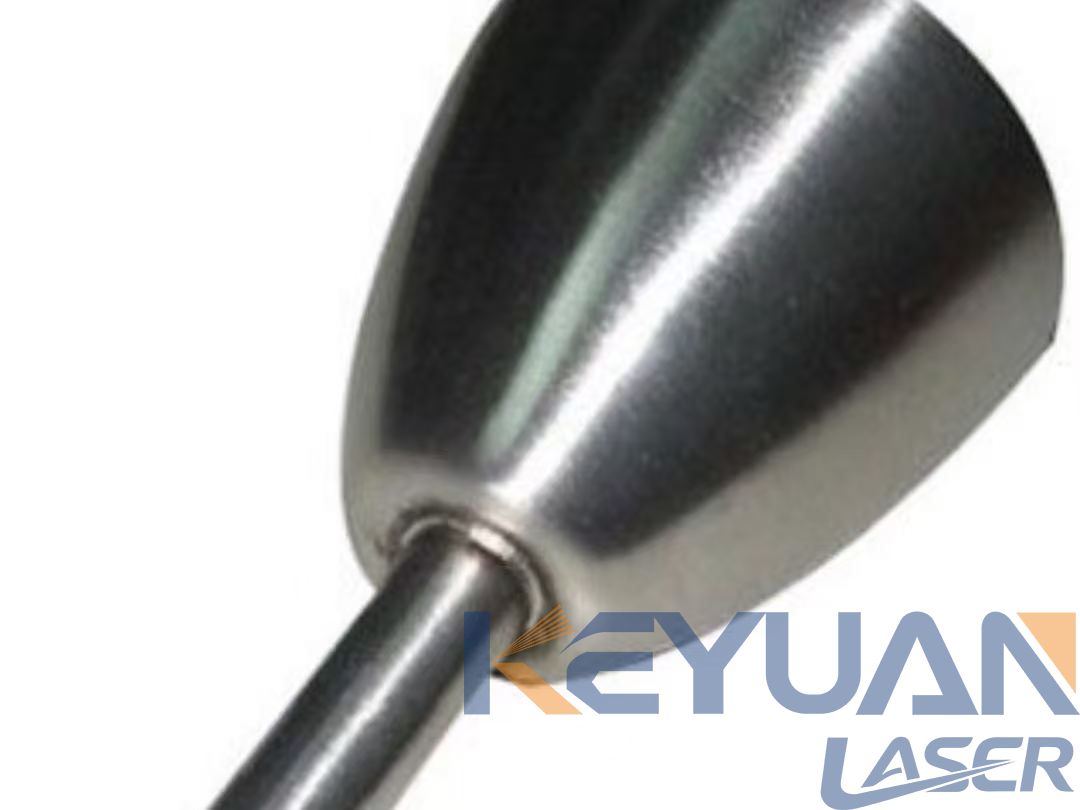
What Integration Actually Means
Strip away the buzzword and a laser welding production line integration project is four things, in this order: a fixture that holds the part in one position, a way to get the part in and out, a way to aim the torch, and a way to keep the machine from starting when someone is standing in the cell.
The multi-function laser welding machine in the KEY-1500WaterW / 2000WaterW / 3000WaterW family fits this because it already carries most of what a cell needs: nine metres of cable, nitrogen assist, a drawer-type protective lens changeable from outside the fence, and power adjustment from ten to one hundred percent so one program covers both thin sheet and a heavier seam.
On a bench, positioning is the operator's hands and torch aiming is their eyes. In a cell, positioning becomes a fixture and clamp you own and design, aiming becomes a robot teach point the integrator owns, and safety becomes an interlocked door that comes with the cell. Cycle time follows from all three.
Positioning is what you buy. Most shops arrive with a number measured by hand: "we weld a bracket in twelve seconds." That twelve includes picking up, fixturing, welding, unloading and racking. Automation only touches the welding. If the weld was three of those twelve seconds, the cell might reach five seconds total, not three.
Build the number honestly: time load, weld and unload separately, then ask which you will actually automate. Projects stall when the answer was "all three" but the budget covered only the welding head. A second station with a lift-and-place is often cheaper than a robot upgrade, and usually what makes the cell pay back.
Read the next table as the version we would actually propose. | Work type | Manual cycle | Single-station cell | Two-station cell |
| Single bracket, 2 mm | 12 s | 6 s | 4.5 s |
|---|---|---|---|
| Two identical parts per cycle | 22 s | 9 s | 5 s |
| Six variants, one fixture each | 90 s changeover | 90 s changeover | 45 s if two fixtures parallel |
If your changeover exceeds your cycle, a second fixture running in parallel pays back faster than a faster laser.
Welding, Cleaning, Cutting and What Not to Automate
This machine family is a four-in-one: welding, cutting, cleaning and weld-seam cleaning in one body. On a line that is a real advantage and a real temptation, because the temptation is to put all four in one station. Resist it. Each task has different fume and extraction — welding stainless needs capture at the nozzle, cutting wets the fixture with oxide plume, cleaning deposits particulate on every sensor. Mixing them means one mediocre extraction system instead of four correct ones.
There is also a size limit to write into the layout drawing. Published capability runs to about 0.5 to 8 mm. Inside a fixture with a robot, treat the practical ceiling as lower, because the torch must reach a consistent angle at every point. Parts above roughly 6 mm, or deep V joints filled from both sides, still want a manual welder.
The jobs we refuse to put in a cell are prototypes, repair bays, and anything where incoming material varies by more than a millimetre or two. A cell bets that the next part is identical to the last one; when it is not, the fixture becomes a source of variation.
Cooling, Gas and the Services Behind the Cell
Two services decide whether a cell runs for six hours or six months. Water cooling is not optional above 1500 W. The KEY-1500WaterW and KEY-2000WaterW run on single-phase 220 V, the KEY-3000WaterW needs three-phase 360 V, which often means a new feed from the distribution board rather than a free wall socket. Plan that route before ordering, because its lead time exceeds the machine's.
Nitrogen matters in a way it does not on a bench. An open bench lets a worker step away while gas lingers; a sealed cell concentrates whatever the process makes, and nitrogen assist keeps producing oxide fume the extraction must clear. Size extraction for the duty you run — a cell on two shifts has to hold up at night.
| Service | Bench requirement | Cell requirement | Common failure |
|---|---|---|---|
| Electricity | One wall socket | Dedicated feed, three phase for 3000 W | Ordered machine, discovered the board cannot take it |
| Cooling water | Chiller with its own circuit | Manifolded supply, return to one chiller or two | One chiller serving two stations with no spare |
| Gas | Small bottle at the bench | Bulk tank or manifold outside the cell | Bottle inside the cell, which nobody should do |
| Extraction | Hood near the torch | Captured at the nozzle plus general ventilation | Duct sized for the bench, doubled for a running cell |
How to Buy the Integration
Buy the integration as a project, not a machine plus a robot. The integrator should own four items in writing: cycle time at your part's real geometry, changeover time, and what the cell does when a part fails inspection or the door opens mid-cycle. Ask them to run your actual parts, not demo coupons — a cell that keeps welding an empty fixture is a scrapped fixture and possibly a scrapped torch head.
Our own view: a shop below about fifteen minutes of daily welding on one part family should stay with a handheld laser welding machine and spend the budget on a better fixture and a fume arm. Above a few hours a day on a stable part family, a cell is the better money.
FAQ
How long does a laser welding production line integration take to install?
Four to twelve weeks is normal, and electrical work is the long pole, not the welding. A three-phase feed for a 3000 W machine can add weeks on its own.
Can we keep our existing handheld welder and add a robot around it?
Sometimes, if it takes remote start and holds a stable focus. Many handhelds do not expose those signals cleanly, so test before designing around it.
Does the cell need a safety enclosure?
In most jurisdictions yes, because a 1500 W continuous fiber welder is a serious eye hazard. Interlocked doors or a light curtain are the usual route, and the integrator handles that, not your welding supplier.
What is the realistic payback period?
For a stable part family welding all day, typically under two years. For short runs or frequent changeovers it can disappear — which is why changeover time belongs in the purchase decision.
The Short Version
A laser welding production line integration pays off when three conditions hold at once: the part is the same tomorrow as today, the welding is long enough in a day to matter, and the cycle is dominated by loading rather than the arc. Miss any one and you have bought an expensive way to weld faster than you needed to.
Time load, weld and unload separately. Stay on the bench if the numbers do not line up; buy the water-cooled welding range plus a cell if they do.
label:
related news


E-mail address:
Hotline:
Copyright © 2012-2026 Keyuan Laser All rights reserved