English
 Français
 Deutsch
 Русский
 Türkçe
 Español
 لالعربية
 Português
 Italiano
 ไทย

UV Laser Marking: Cold Marking for Plastics, Glass and PCBs
release time:
2026-10-09
At 355 nm a UV laser breaks polymer bonds instead of melting them, which is how it marks PC, HDPE and glass without yellowing. Where it still fails, and why.
A German packager sent us black polycarbonate connectors last year. Their 20 W fiber marker had burned every serial number into a crater, and the plastic around the text yellowed and craze-cracked within a week.
Polycarbonate absorbs almost nothing at 1064 nm, so the beam dumped heat into the bulk. The fault was wavelength, not power.
At 355 nm the same connector leaves the fixture cool, carrying a white code that survives an alcohol wipe. That swap is what UV laser marking means, and it costs two to three times an equivalent fiber marker.
Why 355 nm Cuts Instead of Cooks
A 1064 nm fiber photon carries 1.17 eV. A 355 nm photon carries 3.49 eV, nearly three times as much, inside a pulse a few nanoseconds long.
Polymer chemistry sets the bar. A carbon-carbon backbone bond needs about 3.6 eV to break, a C-Cl bond 3.4 eV, a C-N bond near 3.0 eV, and a 355 nm photon lands right at that threshold. Where two photons overlap inside the focus the energy is past it, so the polymer breaks into volatile fragments instead of melting. The trade calls this cold laser marking.
Fiber takes the other route. Plastics and clear glass are almost transparent at 1064 nm, so the energy spreads as heat and the removal becomes thermal ablation: a re-solidified skin and a heat affected zone hundreds of microns deep. On a 2 mm wall that warps the part.
Focus is the second dividend. Spot size scales with wavelength, so through the same 110 mm lens a UV beam lands near a third the diameter of an infrared beam, 10 to 20 µm.
What UV Marks Well, and the Polyolefin Surprise
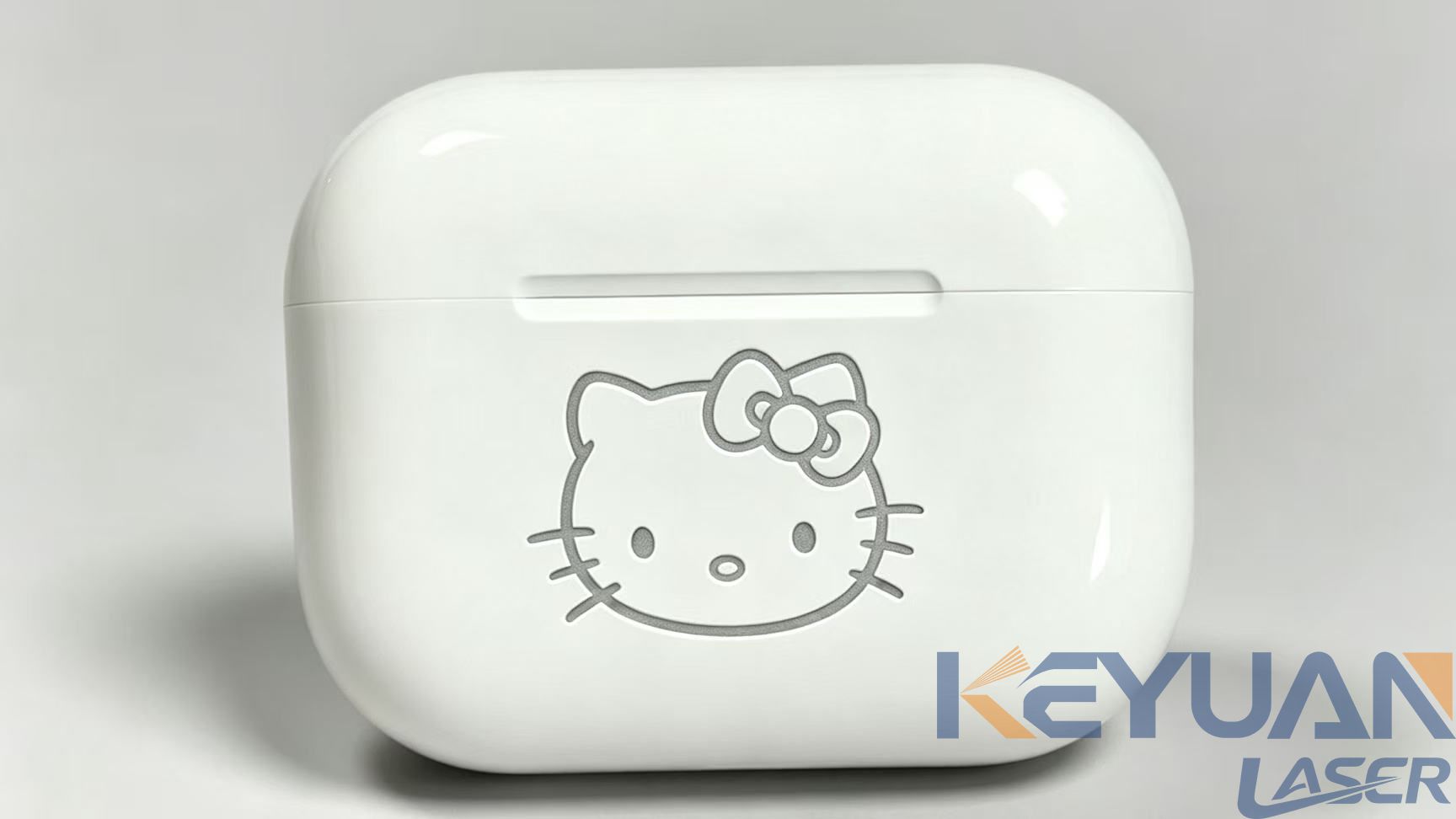
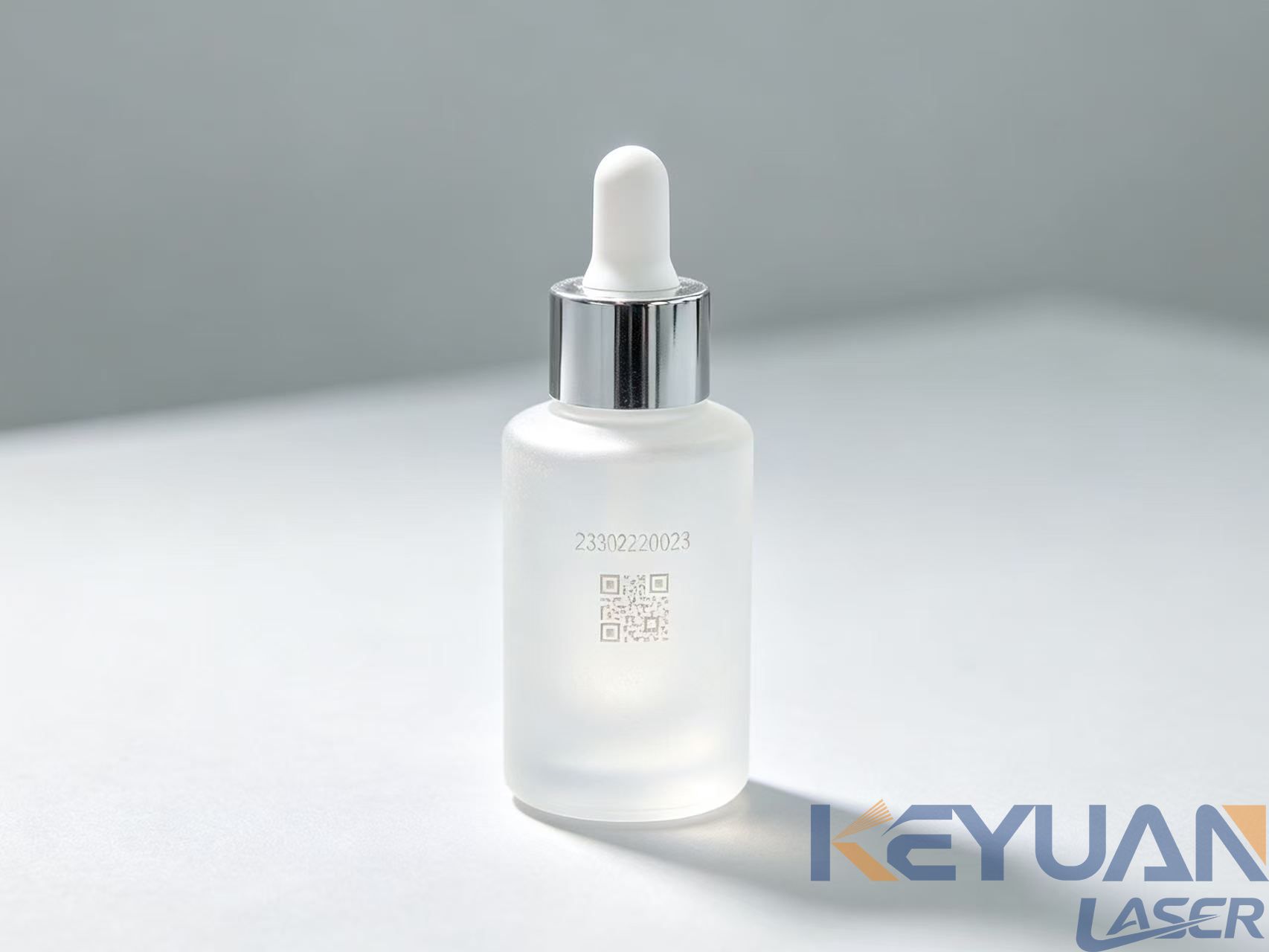
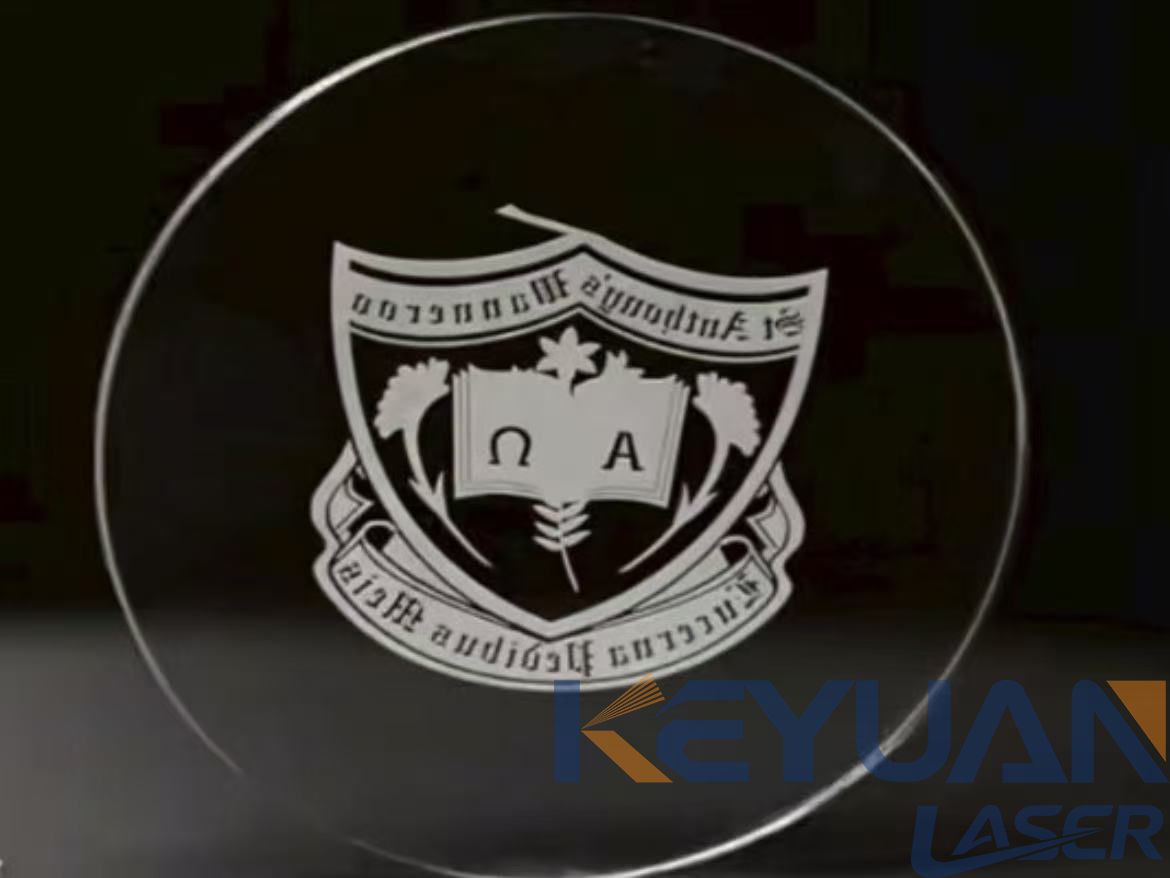
ABS, PC, PS, PET and rigid PVC take high contrast on their own, white on dark grades and dark on natural ones, by controlled surface decomposition rather than pigment. A UV laser engraving machine for glass leaves a frosted, tactile mark without the micro-cracks that scribing causes. Anodized aluminum, powder coat, painted steel and PCB solder mask strip to a controlled depth at very low power, though photo-imageable solder mask is UV-sensitive and needs a validation panel. PE and PVC tubing, PET blister film and coated foil mark cleanly, which is where most laser marking for medical device packaging projects lands.
Then there is the group that catches people out. Plain HDPE and PP mark nothing useful at 355 nm, or at 1064 nm, because the resin has no absorption there and no chromophore to react with. On a black HDPE cap you get a faint glossy scuff.
HDPE laser marking becomes real only when the resin carries a laser-sensitive additive: a masterbatch loaded at 0.5 to 2 percent by weight and compounded into the pellet before molding. Layered double hydroxide and metal salt packages are the usual chemistry.
So this is a design decision, not a purchasing one. If 500,000 caps are already in the warehouse, a UV laser marking machine for plastic will not rescue them. Print a label, or see the machines we build for plastic parts.
Power and Field Size: What Each Watt Actually Buys
UV sources in this class come at 3, 5, 10 and 15 W. Wattage sets how much material you convert per second, not how fine the mark is; the lens does that.
| Power | What it is good for | Where it runs out | System price |
|---|---|---|---|
| 3 W | Fine text on tubing, small 2D codes, thin coatings | Filled areas over 10x10 mm, and glass is slow | USD 6,000-9,000 |
| 5 W | The default for plastics and coated metals | Glass frosting over 0.1 mm, high-volume lines | USD 8,000-13,000 |
| 10 W | The same marks at double the speed, heavier glass work | Dark polycarbonate warms if you push the duty cycle | USD 13,000-18,000 |
| 15 W | Filled logos, dense PCB marking, high throughput | Thin film substrates, and the module bill | USD 17,000-24,000 |
Field size is where buyers get disappointed. An F=110 mm lens gives about 70x70 mm, F=160 mm gives 110x110 mm, and F=254 mm reaches 175x175 mm, with the spot growing from 15 µm to 40 µm as power density falls.
The trade is unavoidable. A 2 mm code wants the short lens, a 150 mm bottle the long one, and anything between needs two indexed passes and a visible seam.
Speed, Cycle Time and Where Throughput Really Goes
Galvo speed runs 700 to 2,000 mm/s and almost never sets your output.
Average power does. At 5 W you have a fixed energy budget every second and hatch spacing spends it: a 0.03 mm hatch across a 10x10 mm filled block means about 330 passes, and 0.01 mm triples the time. A 2x2 mm Data Matrix lands in 0.2 to 0.4 seconds, a 20x20 mm logo in 4 to 8 seconds, and a 40 mm frosted bottle in 6 to 12 seconds at 10 W.
Handling goes on top. On a manual bench a 6 second mark becomes a 20 second cycle once you open the door, seat the part and close it. With a split head over a conveyor, the laser time is the cycle time and the same head runs 8,000 to 15,000 small parts an hour.
Contrast Control and Fume Extraction
On black PC or black ABS the white mark is a foam. The beam decomposes a thin surface layer and the escaping gas leaves micro-voids that scatter light back. Keep energy per pulse low, raise frequency to 60 or 100 kHz, and run three passes at 40 percent power rather than one at 90 percent. A hot single pass leaves a raised ridge and flakes within months.
Light and natural colored plastics flip to carbonization and mark dark. Hatch density of 0.01 to 0.02 mm gives a solid field, and a focus offset of 0.1 to 0.3 mm widens the spot and smooths the tone.
Durability deserves an honest sentence: a foamed white mark is not as hard wearing as a fiber mark annealed into stainless. Wipe it with alcohol and tape it before you promise a ten year label life.
Extraction is not optional. PVC is about 57 percent chlorine by weight and releases hydrogen chloride when ablated, and HCl plus moisture is hydrochloric acid. That attacks lens coatings and galvo mirrors. We have seen a 10 W head lose its output window inside a year on unextracted PVC, so PVC needs an alkaline scrubbing stage and a dedicated duct.
ABS gives off styrene and acrylonitrile, PC releases phenol traces, and both want HEPA H13 plus carbon. Size for 200 to 400 m3/h at the nozzle, not the 60 m3/h extractor bundled inside a cheap enclosure.
Source Life and Machine Configuration
A 355 nm source does not last as long as a fiber module. Expect 15,000 to 20,000 hours at rated output, against roughly 100,000 hours for fiber.
Output fades before it stops. Around 12,000 hours you begin nudging power up to hold contrast, so log your commissioning settings and re-check every 2,000 hours.
Replacement is the cost that catches people. A 5 W module runs USD 2,500 to 4,000 and a 10 W module USD 4,000 to 7,000, plus fitting: 20 to 30 cents an hour over the rated life, trivial on a two-shift line and hard to justify at forty parts a day.
Configuration matters too. A desktop unit puts the laser, galvo and controls in one cabinet behind a manual door, which suits batch work on small parts. A split head sits on a 2 to 3 m umbilical so it can bolt inside a safety enclosure, sit over a conveyor, or hang on a robot wrist, and buyers integrating onto a line usually take the split-type UV marking head.
FAQ
How long does a UV laser source last?
Expect 15,000 to 20,000 hours at rated output. Output decays gradually from roughly the 12,000 hour mark, so you raise power slightly to hold contrast.
Can a UV laser mark HDPE without additives?
No, and this is the misunderstanding we deal with most. Plain HDPE and PP have no absorption at 355 nm, so you get a faint glossy scuff rather than a readable mark. The fix is a masterbatch at 0.5 to 2 percent by weight.
What wattage do I need for plastics?
5 W covers most plastic and coated-metal marking, including medical tubing and small 2D codes. Move to 10 W for higher throughput or heavier glass work. 3 W runs out of power on filled areas, and 15 W brings a bigger module bill.
Does UV marking damage the surface?
Less than infrared marking, but not zero. HAZ typically runs 10 to 50 µm and the part leaves the fixture at ambient temperature, which is why the process suits thin walls. Validate anyway: alcohol wipe, tape test, abrasion spec.
Can a UV laser mark metal?
On coated and anodized metal, yes, and extremely well. Bare metal is a different conversation: UV makes a shallow mark a few microns deep with modest contrast. For deep engraving, large parts or high-volume metal marking, a fiber or MOPA source is the right tool.
Where UV Loses, and What It Replaces
If you need 0.3 mm of engraving depth in 3 mm steel, UV is not the answer. A UV head removes microns per pass on metal while a fiber source removes tenths of a millimeter. Metal color work on stainless belongs to a MOPA laser marking machine, which grows a chromium oxide film you tune with pulse width control.
Size is the other boundary: a 175x175 mm field is the ceiling for a galvo head, so a 400 mm panel is a fiber job.
Where UV wins is on the jobs other processes fail. Against the three it usually replaces, the economics land like this.
| Process | Setup per design | Cost per part | Durability | Where it wins |
|---|---|---|---|---|
| UV laser | None, a vector file | Near zero after capex | Permanent, alcohol resistant | Variable data, heat-sensitive parts |
| Pad printing | USD 150-400 per plate | USD 0.02-0.08 plus ink | Wears, solvent sensitive | 3D shapes, opaque colors on light plastics |
| Inkjet (CIJ/TIJ) | Low, no tooling | USD 0.002-0.02 | Poor, wipes off with alcohol | Date and lot codes on secondary packaging |
| Hot stamping | USD 200-600 per die | USD 0.01-0.05 for foil | Good | One fixed design at very high volume |
Run the arithmetic first. An 11,000 USD UV system against hot stamping at USD 0.03 per part breaks even around 370,000 parts; under 50,000 parts a year, most shops we quote are better off printing.
On a Class II device the regulatory argument settles it before the arithmetic. The mark has to survive transport, sterilization and end-user handling, produced without ink that can migrate into the sterile barrier.
Send us the material, mark size and volume per shift, and we will tell you whether UV is right. If the answer is a fiber head, we will say so.
label:
related news


E-mail address:
Hotline:
Copyright © 2012-2026 Keyuan Laser All rights reserved