English
 Français
 Deutsch
 Русский
 Türkçe
 Español
 لالعربية
 Português
 Italiano
 ไทย

Laser Welding Machine Power: How Many Watts You Need
release time:
2026-10-13
Work out the watts a laser welding machine needs from the steel you actually weld, plus how cooling, duty cycle and fit-up change the answer before you buy.
The first question almost every buyer asks is how many watts. It is also the question that gets the worst answers, because the honest reply starts with a different number: the thickness you weld most often.
Get that number right and the wattage picks itself. Get it wrong and you buy either a machine that cannot reach penetration or one that blows holes in the thin panels that make up most of your work.
Watts Are Not the Whole Story
Power sets the ceiling on how deep the beam can melt in one pass. Everything else about the machine decides whether you ever reach that ceiling.
What matters alongside the wattage is the spot size at the focus, how fast you can move the head, and how well the two edges line up. A 1500 W machine with a tight spot and a steady hand beats a 3000 W machine that spends its energy heating a gap. If you are still working out whether laser welding suits your shop at all, the honest answer is that fit-up decides more jobs than power does.
The Three Power Classes in Plain Terms
| Machine class | Steel it welds in one pass | Typical travel speed | Cooling |
|---|---|---|---|
| 1000 W | Up to about 1.5 mm | Slow, controlled | Air |
| 1500 W | 1.5 to 2.5 mm | Medium | Air, or water for long shifts |
| 2000 W | 2.5 to 3.5 mm | Fast | Water |
| 3000 W | 3.5 to 5 mm | Fastest | Water |
Those numbers assume a square butt joint on clean mild steel with a good fit. Add a gap, rust or a heavy mill scale and the same machine loses one or two millimetres of reach, which is why buyers who quote tank thicknesses from a catalogue are usually disappointed.
The other thing to notice is how little the extra reach costs you in price compared with what it costs elsewhere. Doubling the power roughly doubles the electrical draw and the weight of the head, and it does nothing for the thin sheet work.
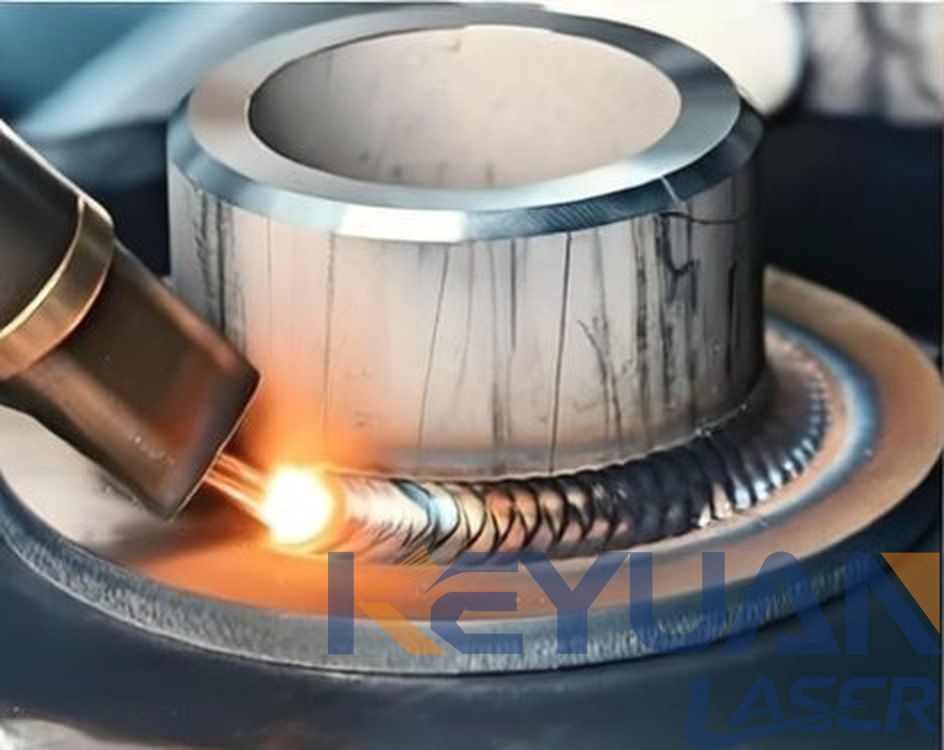
Match the Number to the Thickness You Weld
Look at your last fifty jobs before you look at a spec sheet. Sort them by material thickness and see where the weight of the work sits.
Most sheet metal shops find that eighty percent of their seams sit between 1 mm and 2 mm. That is 1500 W territory, and it is why the 1500 W handheld laser welding machine is the model we ship most. It welds a 1 mm cabinet seam at a comfortable speed and still reaches 2.5 mm when a bracket shows up.
The picture changes in a different shop. If you build frames, tanks or structural parts, the work sits at 3 mm and above, and a 2000 W or 3000 W unit stops being a luxury. On those parts, the extra power buys penetration in a single pass, and a single pass is the whole point. Two passes cost you the clean appearance that made you look at laser welding in the first place.
There is a middle path worth knowing about. Many buyers take a laser welding machine that also cuts and cleans, because on mixed work the cleaning function saves more time than another 500 W ever will.
Why a Bigger Machine Can Weld Worse
Here is the part the brochures leave out. A high-power machine is harder to use on thin material, not easier.
At 3000 W a 1 mm panel heats to burn-through in a fraction of a second. The operator has to move faster than most people can move by hand, so the shop ends up turning the power down to thirty percent and welding with a machine it paid full price for. You lose nothing in quality, but you paid for reach you never touch.
There are other bills too. A 3000 W unit needs a serious supply at the wall, often three phase, and that alone rules it out of some workshops. The head is heavier, so an operator working overhead tires sooner. The chiller takes floor space and needs its own maintenance.
We usually steer buyers away from the biggest machine they can afford and toward the smallest one that covers ninety percent of their parts. The budget that is left over goes into a fixture, a fume arm, or a second gun, and all three raise output more than another thousand watts.
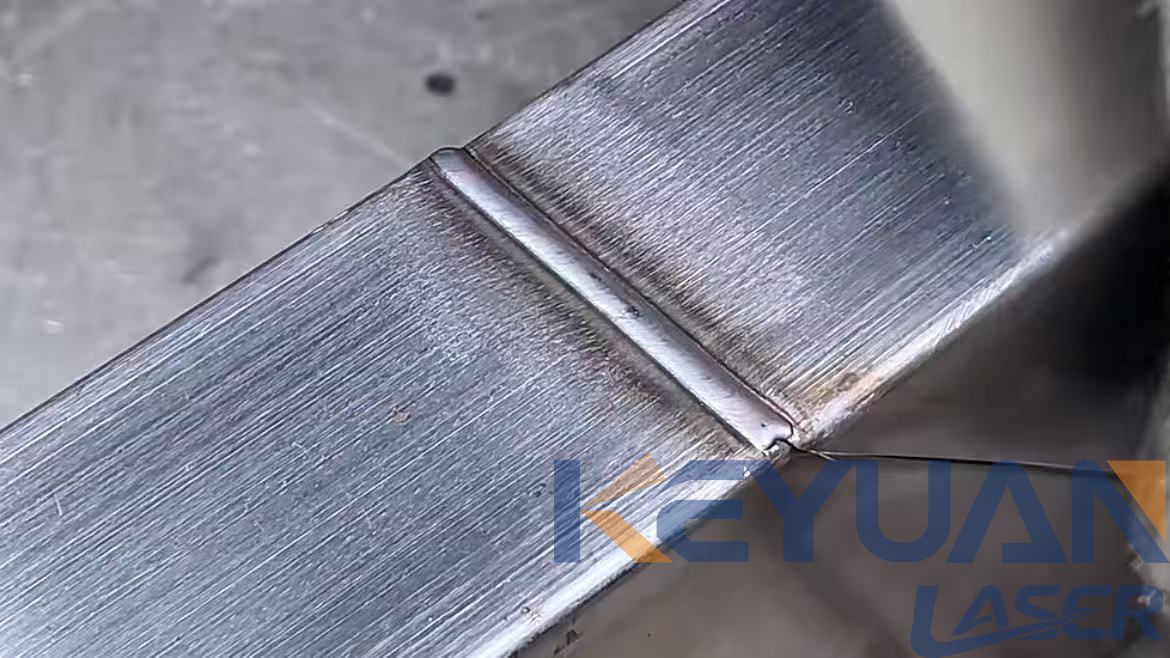
Cooling, Duty Cycle and the Real Limit
The cooling method decides how long you can actually weld, and that is where quotes quietly differ.
| Item | Air-cooled | Water-cooled |
|---|---|---|
| Power range it suits | 1000 to 1500 W | 1500 W and above |
| Duty cycle | Drops in a hot shop | Continuous |
| Where it belongs | Site work and small shops | Production cells |
| What to watch | It de-rates in summer | Chiller maintenance and space |
Air-cooled welding is where most small shops should start. There is no chiller to buy, nothing to service, and the unit moves between benches or travels to site in a van. The trade is heat. In a workshop at 35 degrees the machine will slow itself down to protect the source, and on a long seam that slowdown is what you feel.
Above 1500 W, air-cooled laser welding usually turns into a compromise too far, and that is when water cooling earns its floor space.
Water cooling removes that ceiling. A water-cooled unit holds full power all day, which is what a production cell needs, and the price is a chiller that wants its filter cleaned and its water checked. If most of your work is short seams on a bench, air is enough. If you weld all day, water is cheaper than the second machine you would otherwise buy.
FAQ
Is 1500 W enough for 3 mm steel?
Not in one pass at a comfortable speed. You will get penetration on a tight butt joint, but you will be running near the limit and the finish will suffer. If 3 mm is normal work rather than an exception, step up to 2000 W.
Does more power mean a faster weld?
Only up to a point. Speed follows the power to thickness ratio, and once the machine has more reach than the joint needs, the travel speed is limited by the operator and the fixture, not by the watts.
Can I weld aluminium with the same machine?
Usually yes, with a different recipe. Aluminium reflects more of the beam and conducts heat away fast, so it behaves like a thicker material. Expect to lose roughly a third of the reach you get on steel.
Do I need three-phase power?
Below about 1500 W most units run on single phase, which is why small shops manage. Above 2000 W three phase is common, so check your supply before you order rather than after.
The Short Version
Pick the wattage from the thickness you weld every day, not from the thickest part you have ever been asked for. For a sheet metal shop with 1 to 2 mm work, 1500 W is the sweet spot. For frames and tanks at 3 mm and up, 2000 W and water cooling earn their price. And whatever you choose, spend some of the budget on water-cooled welding setups and fume extraction, because those are the parts that decide how many hours a day the machine actually runs.
label:
related news


E-mail address:
Hotline:
Copyright © 2012-2026 Keyuan Laser All rights reserved