English
 Français
 Deutsch
 Русский
 Türkçe
 Español
 لالعربية
 Português
 Italiano
 ไทย

Handheld Laser Welding Machine for Steel Structure Workshops
release time:
2026-10-16
What changes when a handheld laser welding machine meets structural steel: which joints it handles, how thickness drives power, and where fit-up beats speed.
A fabricator that has spent ten years welding 1.5 mm stainless cabinets suddenly lands a stair tower job: 100 by 100 by 6 angle iron, 200 mm I-beams, base plates, cleats, and every piece has to fit on site with a crane in the yard.
Same welder, same gun, completely different job. Sheet metal work rewards neatness. Structure work rewards fit-up.
Structural Steel Is a Different Job
The first thing to understand is that a structural joint is carrying load through its weld, not just keeping two sheets together. That changes what you care about.
On a cabinet you measure the gap with a feeler gauge and move on. On a beam-to-column connection the same gap decides whether the connection passes inspection. So the extra time a structure job takes is rarely spent welding. It is spent getting two pieces of steel to agree with each other before the arc starts.
Thickness follows from that. Most sheet metal shops live between 1 and 3 mm. Structure work lives at 6 mm, 8 mm, 12 mm, and a box column wall might be 4 to 8 mm depending on the span. A handheld laser welding machine is comfortable in that range. A machine rated only for thin sheet will fight it.
What a Structure Shop Actually Welds
| Member | Typical joint | Common thickness | What actually slows you down |
|---|---|---|---|
| Angle cleat to gusset | Fillet on both legs | 6-10 mm | Burrs at the edge and rust scale under the cleat |
| Base plate to column | Fillet all round | 8-12 mm | The plate is never flat, so the gap varies |
| Beam to column flange | Fillet or a seat angle | 6-8 mm | Straightness of the cut edge, not the weld |
| Stiffeners on a plate girder | Fillet, short and long | 6-8 mm | Repeatability across a long run |
| Tube to base plate | Fillet all round | 4-6 mm | The tube end is oval after sawing |
| Ladder and stringer | Fillet, tube to flat | 3-5 mm | Climbing over the piece to reach the far side |
Read the last column before you read the thickness column. On most structure jobs the stoppage is cleaning and positioning, not the weld itself.
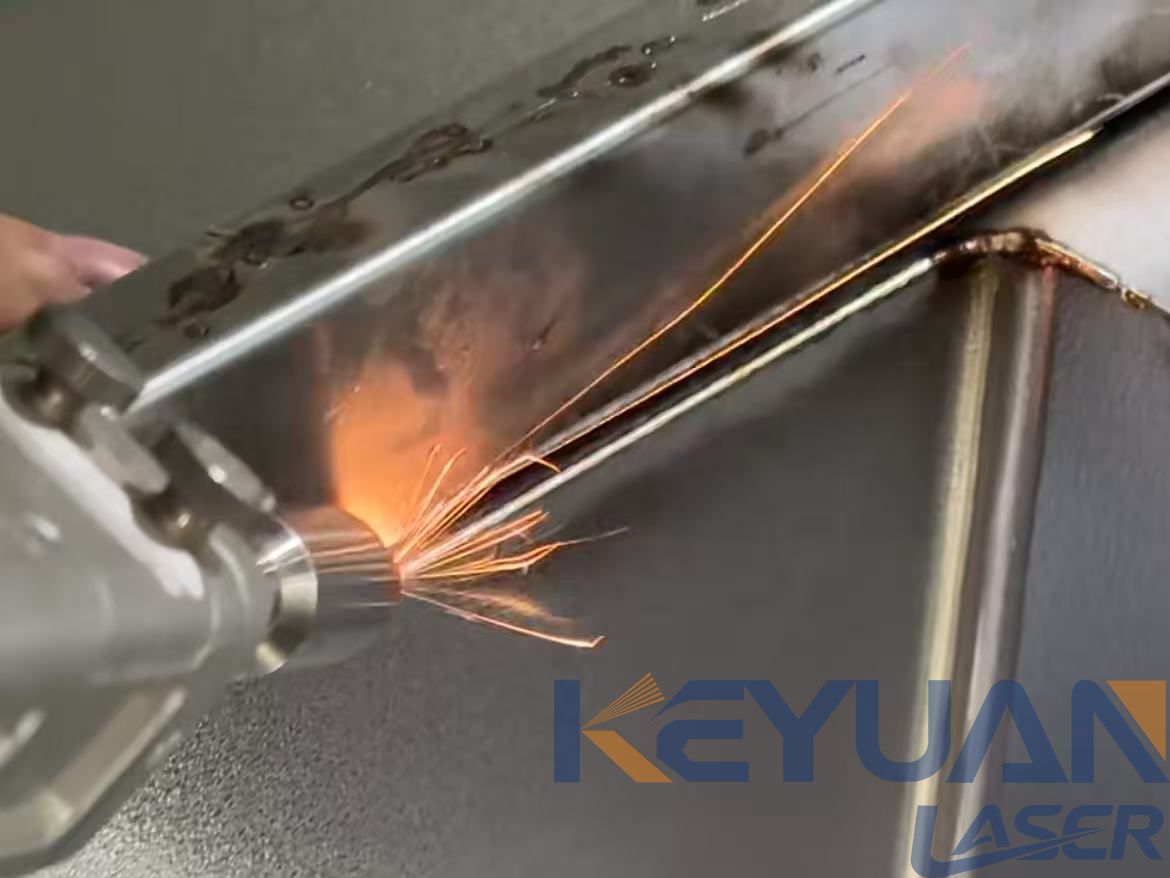
Thickness Decides the Machine
| Plate thickness | Source power that holds a steady arc | Single pass full penetration | What this means for your day |
|---|---|---|---|
| 3 mm and under | 1500 W | Usually | One pass, fast, low risk of burning through |
| 5-6 mm | 2000 W | Usually, with clean fit-up | Weld time is no longer the bottleneck |
| 8-10 mm | 3000 W | Often | Gap control starts to matter more than power |
| 12 mm and above | Above 3000 W | Rarely in one pass | Multi-pass, and it stops being a handheld job |
The published welding range on most handheld machines is 0.5 to 8 mm. That number is honest. Below 8 mm the process is stable and repeatable. Above it you are asking the same small power source to push through a thicker stack while the workpiece stays still and cold, which is the hardest combination there is.
A laser welding machine with a fiber laser welding machine source handles up to 8 mm in a single pass on a typical structural joint. Above that, plan two passes and pre-tacking, and be honest with yourself about cycle time.
Fit-Up Is the Real Skill
If you take one thing from this article, take this: on structural work the fit-up decides the quality, not the machine.
Three habits pay for themselves quickly. Grind the edge of a cut angle until it is bright and square, because the burnished skin that a plasma or saw cut leaves will not weld properly without removing it. Set the gap with a spacer rather than by eye, since a gap that looks right from one side is not. Tack before you commit, because a welded joint that moves is the one you cannot undo.
Add the third habit that only structure work needs: watch the heat sink. A thick column flange pulls heat away from the joint faster than a thin plate does, so the same settings that look fine on a gusset can starve a joint at the flange. Slow the travel or add a second pass rather than raising the power.
In our experience the shops that get real output from a handheld machine on structure work are the ones that put a magnetic clamp and a spacer set next to the gun. It is not glamorous, but it is worth more than a bigger machine.
Where It Wins, and Where It Should Walk Away
A handheld laser welder earns its place on structure work in a few specific places. Field repair of installed steel is the clearest one: no gas cylinders to haul up a stair tower, no chipping slag on a walkway. Mixing jobs is another, because the same gun goes from a 3 mm bracket to a 6 mm cleat without changing anything. And it is very good on repeat short seams across many identical members, where setting the machine once and moving the steel is faster than moving the machine.
There are four cases where it is the wrong tool. Full-penetration butt welds that will be ultrasonically or magnetically tested need a repeatable process with recorded parameters, usually on a dedicated machine. Continuous long seams in seismic or fatigue-loaded members need process qualification. Plate above 12 mm means multi-pass work that a handheld gun handles poorly. And a shop already running a mechanised welding cell will beat a handheld setup on volume every time, because the robot does not need a fit-up clamp to hit the same point twice.
FAQ
Can a handheld laser welder do structural steel?
Yes, up to about 8 mm in a single pass, which covers a lot of cleats, base plates and stiffeners. Beyond that it becomes a two-pass job with much less margin, and you should price the extra time into the quote.
What thickness is too thick for a handheld machine?
Around 12 mm. The published range stops at 8 mm for good reason: thicker plate pulls heat out of the joint faster than a small source can replace it, and the arc becomes unstable.
Do structural welds need shielding gas?
The filler wire usually carries its own shielding, and the built-in nitrogen unit on some models covers the root pass. Confirm the shielding requirement against your drawing rather than assuming.
What certification do structural welds need?
It depends on your local code and the client. Most structural work requires a qualified procedure and a qualified welder, regardless of process. A laser machine does not exempt you from that, it only changes the parameters you qualify.
The Short Version
Pick a handheld laser welding unit in the 2000 to 3000 W range and you will cover most structural fitting-up work on site. Budget more for preparation than for the gun: edge grinding, spacers, clamps and tack points are what turn a fast weld into a good one. And if the work is full-penetration, fatigue-critical, or above 12 mm, buy a process you can qualify rather than one you can move. Once you know the joint is a fillet on clean, prepared steel, water-cooled laser welding will keep its rating through a full shift, which is where structure work lives.
label:
related news


E-mail address:
Hotline:
Copyright © 2012-2026 Keyuan Laser All rights reserved