English
 Français
 Deutsch
 Русский
 Türkçe
 Español
 لالعربية
 Português
 Italiano
 ไทย
Laser Cleaning: Rust, Paint and Weld Prep Without Blasting
release time:
2026-09-30
Laser cleaning lifts rust, paint and weld heat tint off steel with no media and no chemicals. Coverage rates, the jobs it cannot finish, and the payback case.
A Dutch fabricator asked us last spring whether a laser could replace their blast booth. They were cleaning 1.8 m welded frames and paying to haul away 40 kg of spent garnet and paint sludge a shift.
The honest answer: it could take over most of the rust and paint work, none of the salt contamination work, and all of the weld prep. That split decides whether payback lands in eighteen months or never.
How a Pulsed Beam Lifts Rust Off Steel
It looks like burning. It isn't.
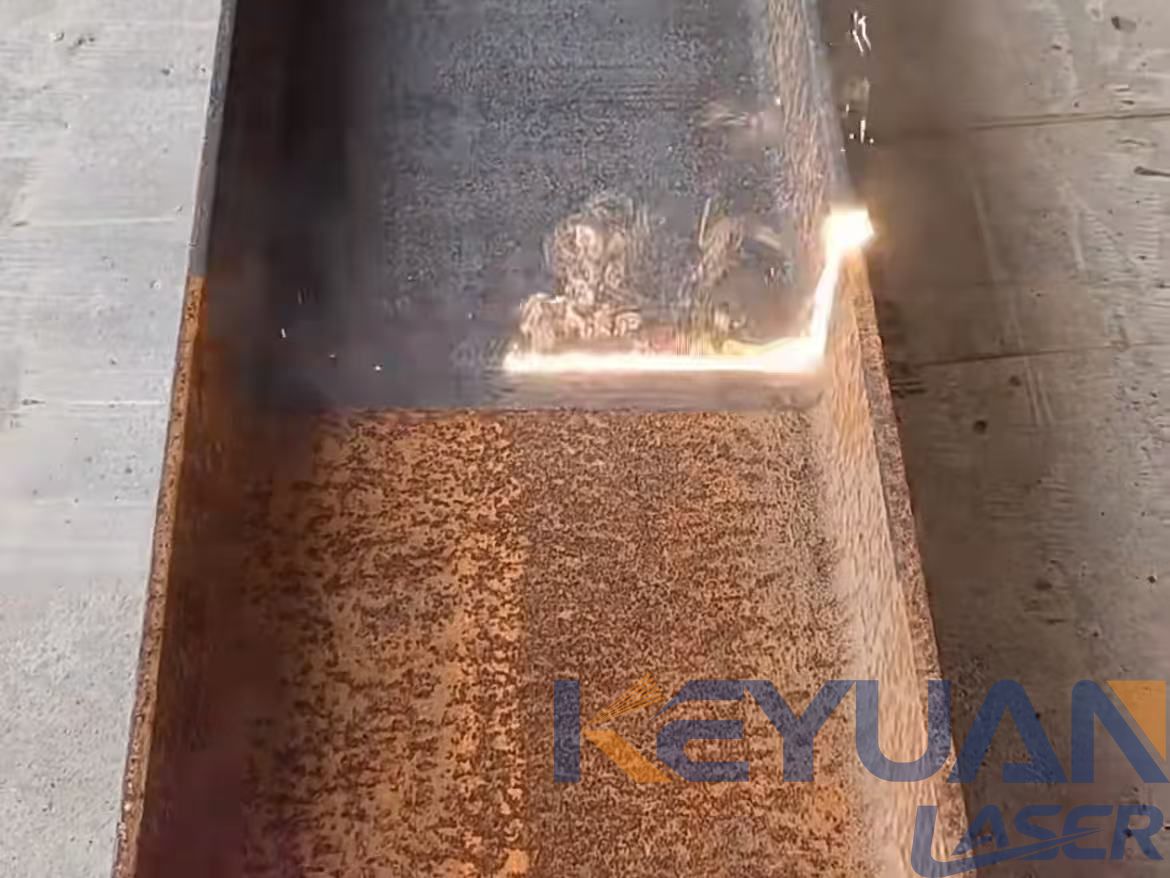
At 1064 nm, iron oxide absorbs the beam far better than the steel underneath it. Rust, mill scale, paint pigment and heat tint couple with that wavelength, while polished bare metal mostly reflects it. Energy deposits in the contaminant layer, which heats by several hundred degrees in nanoseconds and tries to expand more than the substrate beneath it can follow. The strain across that interface breaks the bond.
Push fluence above roughly 1 to 5 J/cm², and the threshold moves with the material, the layer ionises and a plasma plume forms above the spot. That plasma acts as a shock front and flicks the loosened oxide off rather than vaporising it, so a 1 mm panel survives the pass.
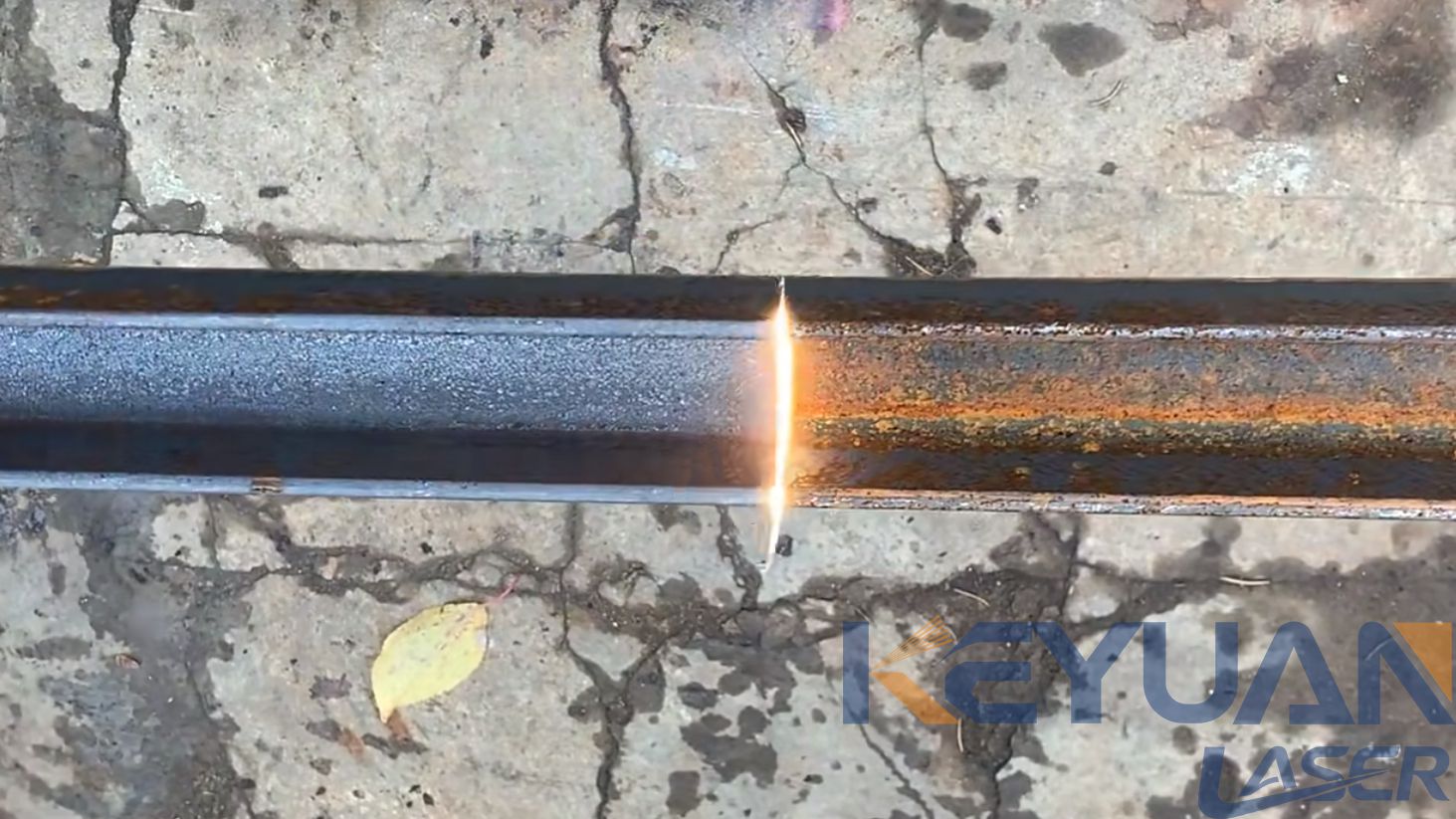
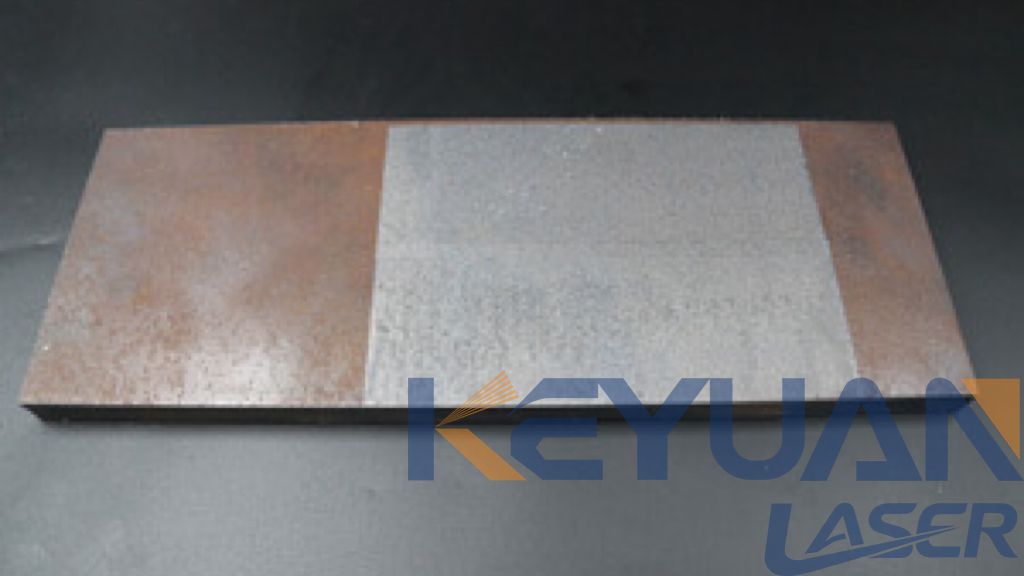
Selectivity is the selling point. A blast nozzle cannot tell rust from the steel under it, and neither can a grinding disc. A laser cleaning machine stops cutting when it meets material that reflects instead of absorbs, leaving mill finish on 304 sheet rather than a gouged stripe.
Continuous Wave or Pulsed, and What Wattage Buys
The continuous vs pulsed laser cleaning decision is a heat-input decision. A continuous wave (CW) source emits an unbroken beam, quick and cheap per watt on flat plate with light oxide or a thin oil film. Heat is the weakness: hold a 1000 W CW head still on 1.2 mm cold-rolled sheet and the colour shifts before the buckle appears. Pulsed sources deliver energy in short bursts with cooling gaps between them, so average heat input stays low. For thin sheet, delicate substrates and uneven rust needing several passes, we steer buyers toward a pulsed laser cleaning machine rather than a CW unit.
Wattage sets coverage. A 100 W head handles fingerprints, oils and flash rust at 1 to 2 m²/h. 200 W is the volume seller for surface rust, paint and weld prep. A 300 W pulse laser cleaning setup starts to move mill scale at 1.5 to 2.5 m²/h, 500 W takes scale in one pass, and 1000 W makes powder coat and large moulds practical. Ship sections want 2000 W and up.
On a large flat rusty area, a blasting crew is still faster per square metre than a 200 W head. Lasers win on preparation quality and waste, not on a coverage race against garnet.
Defocus distance and scan width decide what happens at the surface. Running 20 to 40 mm off focus gives a wide soft line that covers ground quickly, with a fluence drop thick rust ignores. Moving closer puts the beam on a narrow stripe that suits weld seams and ruins thin skins. Scan width trades the same way: 60 to 80 mm at 1000 W lifts light oxide fast, a 10 to 20 mm line shifts mill scale.
What It Removes, and What It Will Not Do
| Contaminant | Right call? | Conditions and numbers |
|---|---|---|
| Flash rust, surface rust | Yes | 100-300 W, one pass, 1-2.5 m²/h |
| Heavy flaking rust | Yes, slowly | Several passes at 300-1000 W; blasting wins on plate |
| Mill scale, hot-rolled | Yes | 300 W up, 20-40 mm defocus, 40-60 mm scan |
| Paint and powder coat | Usually | Thin coats one pass; thick epoxy several passes |
| Oils, release agents | Yes | Lowest power, no substrate effect |
| Weld heat tint | Yes | 200 W at 20-30 mm scan, replaces pickling paste |
| Mould, rubber, adhesive | Yes | 100-300 W on polymer tooling |
| Deep pitting corrosion | No | Surface cleans, pits stay. Needs weld repair |
| Chlorides and salt | No | Fails the salt spray test; chemical wash needed |
| Removing 1 mm of metal | No | Milling or grinding, not cleaning |
Deep pitting corrosion is a shape problem, not a cleanliness problem. A laser rust removal machine strips oxide out of a pit and leaves the pit where it was, so a coating spec calling for a smooth profile means weld repair or filler.
Salt is worse because it is invisible. Chlorides from marine exposure or a pickle line sit in the grain boundaries; one laser pass makes the surface look factory-new while the coating still fails the salt spray test. Our rule is laser first, then a de-ionised water or phosphoric wash, then a chloride test strip before painting.
Mould and tooling work is the quiet winner here. Release agent and rubber residue come off injection moulds and packaging machinery tooling without solvent.
Weld Prep and Post-Weld Cleanup
The strongest commercial case for this equipment is not rust. It is weld prep.
Laser cleaning for weld prep on TIG stainless replaces the grinder and its contamination. An oxide or mill scale layer under the arc gives an unstable start, penetration that wanders, and joints you scrap. The traditional fix is a grinding disc that drives iron into the surface, then an acetone wipe. A 200 W pulsed head takes the oxide off in two passes at a 20 to 30 mm scan width and embeds nothing, so arc start becomes repeatable and penetration stays even.
After welding, the same head lifts heat tint off 304 and 316 without acid pickling paste. A hazardous chemical leaves the shop, the rinse water disappears, and a finished assembly gets cleaned in place instead of dipped. Pickling paste still makes sense where a whole surface needs passivating; for a seam and its heat-affected zone the laser is faster.
Substrate Risk, Blast Profile and Safety
Heat is the first way to hurt a part. On 0.8 to 1.2 mm sheet, lingering on one spot warps the panel before the rust is gone. Keep the head moving, stay defocused, drop to 100 to 200 W.
Over-cleaning is second. The beam has no idea where the contaminant ends; too slow or too tight a focus strips into base metal, and on stainless that removes the chromium-rich layer.
Profile is the trap. Blasted steel carries an angular anchor pattern, specified as SA 2.5 with a 40 to 70 µm profile. Laser-cleaned steel is smoother, because the beam lifts contamination rather than cutting metal. Adhesion is often good, but if the drawing says SA 2.5, laser cleaning does not produce it, so do not accept the job.
Safety is not optional. Old paint can release lead, chromate or isocyanate residues, so test the coating before stripping and match the extraction filter to what you find. Handheld heads need extraction at the nozzle, because the process makes fine particulate, not just gas. Eyewear rated for 1064 nm is mandatory, reflections included, and fixed gantry units belong in a Class 1 interlocked enclosure.
Handheld Ergonomics, Gantry Work and the Cost Case
A handheld laser cleaning machine in the 100 to 200 W class, on a 5 to 10 m fiber, weighs 3 to 5 kg and one operator can run it for a full shift. A 3000 W head is heavier, with water lines and cable drag behind it, and we do not sell it as an eight-hour tool.
Bringing the head to the part only makes sense when the part cannot come to the machine. Welded frames, ship sections, pipeline spools and large moulds are where handhelds earn their keep; anything that fits on a table and repeats a few hundred times a month belongs on a gantry.
Running cost is mostly electricity. A 300 W pulsed unit draws 2 to 3 kW at the wall including the chiller, so at €0.25/kWh you are under €1 per hour. What disappears is blast media, spent garnet, paint sludge disposal and the waste permit. Capital cost is the trade. Build the model as monthly blasting hours × media and disposal cost per hour, plus chemical stripping spend, plus grinding consumables and labour, against machine capital over three years.
Where cleaning is occasional and welding is the main event, a dedicated cleaning head sits idle most of the week. That is the case for a 4-in-1 laser welding machine, which welds, cuts and cleans from one head. Most shops we quote would rather own one machine covering three jobs adequately than three that cover one each perfectly.
| Laser cleaning | Sandblasting | Chemical stripping | Wire brushing | |
|---|---|---|---|---|
| Waste stream | Filtered fume | Media and paint sludge, disposal | Acid or solvent waste, permits | Dust and brush wire |
| Consumables | Window, lens, power | Garnet or bead, nozzles, PPE | Chemicals, tank time, rinse water | Brush wheels |
| Substrate damage | Low if parameters suit the sheet; thin plate can warp | Cutting profile, media embedment | None mechanical; etches if left on | Scratches, embedded iron |
| Speed, 1 m² surface rust | 1.5-2.5 m²/h at 300 W | 15-30 m²/h in a booth | 30-60 min soak and rinse | 0.5-1 m²/h with a grinder |
| Surface left behind | Smoother than blast, not SA 2.5 | SA 2.5, 40-70 µm profile | Near original, slightly etched | Directional scratches |
| PPE and controls | 1064 nm eyewear, extraction, interlock | Supplied air, blast suit | Gloves, respirator, eye wash | Face shield, dust mask |
| Best fit | Weld prep, heat tint, in-situ work | Large flat areas, blast-profile specs | Whole-surface stripping, big batches | Touch-up, blending |
FAQ
Can laser cleaning remove rust completely?
Surface rust, yes, down to bare metal with enough wattage and a couple of passes. Where corrosion has pitted below the original surface, the pit stays clean but empty.
Does it damage the base metal?
Not when the parameters suit the thickness. Damage comes from technique: holding the head still on 1 mm sheet, or running slowly enough to cut into base metal. Stainless suffers most, because over-cleaning removes the chromium-rich layer.
How fast is it compared to sandblasting?
Slower, and anyone claiming otherwise has not measured. A 200 W unit on surface rust covers about 1 to 2 m²/h; a blasting crew with a proper booth does 15 to 30 m²/h. It wins on weld seams and anywhere waste disposal carries a cost.
Does laser cleaning need consumables?
Very few. A protective window, occasionally a focal lens, plus electricity for the head and the chiller.
Can it be used on aluminium and anodised parts?
Bare aluminium is difficult, because the metal reflects most of the 1064 nm beam and pulls heat away quickly, so the process wants higher fluence and light passes. Anodising is a controlled oxide layer and the laser strips it, usually the opposite of what you want on a cosmetic part.
The Short Version
Laser cleaning replaces sandblasting and chemical stripping on weld prep, heat tint, light rust, oil films and in-situ work, with no media, no chemicals and no waste stream. It loses to a blast booth on large flat areas, cannot refill pitting, and will never pass a salt test alone. Buy for the jobs it wins.
label:
related news


E-mail address:
Hotline:
Copyright © 2012-2026 Keyuan Laser All rights reserved