English
 Français
 Deutsch
 Русский
 Türkçe
 Español
 لالعربية
 Português
 Italiano
 ไทย
How to Choose a Handheld Laser Welding Machine: 7 Specs
release time:
2026-09-30
Seven specs decide whether a handheld laser welding machine welds clean stainless or fights spatter: power, source, gun, cooling, fiber, gas, site power.
A handheld laser welding machine is only as good as seven specs: output power, laser source, welding gun, cooling method, fiber length, shielding gas setup, and site power. Get those right and you can weld 0.5 to 4 mm stainless and carbon steel with minimal distortion. Get them wrong and you spend the life of the machine fighting spatter, incomplete penetration and unplanned downtime.
The order matters. Buyers start with wattage, because that is the number on the quotation, then discover three months later that the gun and the cooling method decide whether the machine earns its floor space.
Output Power Sets the Ceiling
Power sets the ceiling on how thick you can weld in a single pass. It does not, on its own, decide weld quality, and a 2000 W head with a poor gun will lose to a well-set 1500 W machine on a 2 mm stainless cabinet.
| Power | Typical single-pass penetration | Best fit |
|---|---|---|
| 1000 W | 1 to 2 mm | Thin sheet, repair work, low-budget entry |
| 1500 W | 2 to 3 mm | Most sheet metal fabrication, the volume seller |
| 2000 W | 3 to 4 mm | Thicker plate, faster travel speed |
| 3000 W | 4 to 6 mm | Heavy fabrication, high-throughput lines |
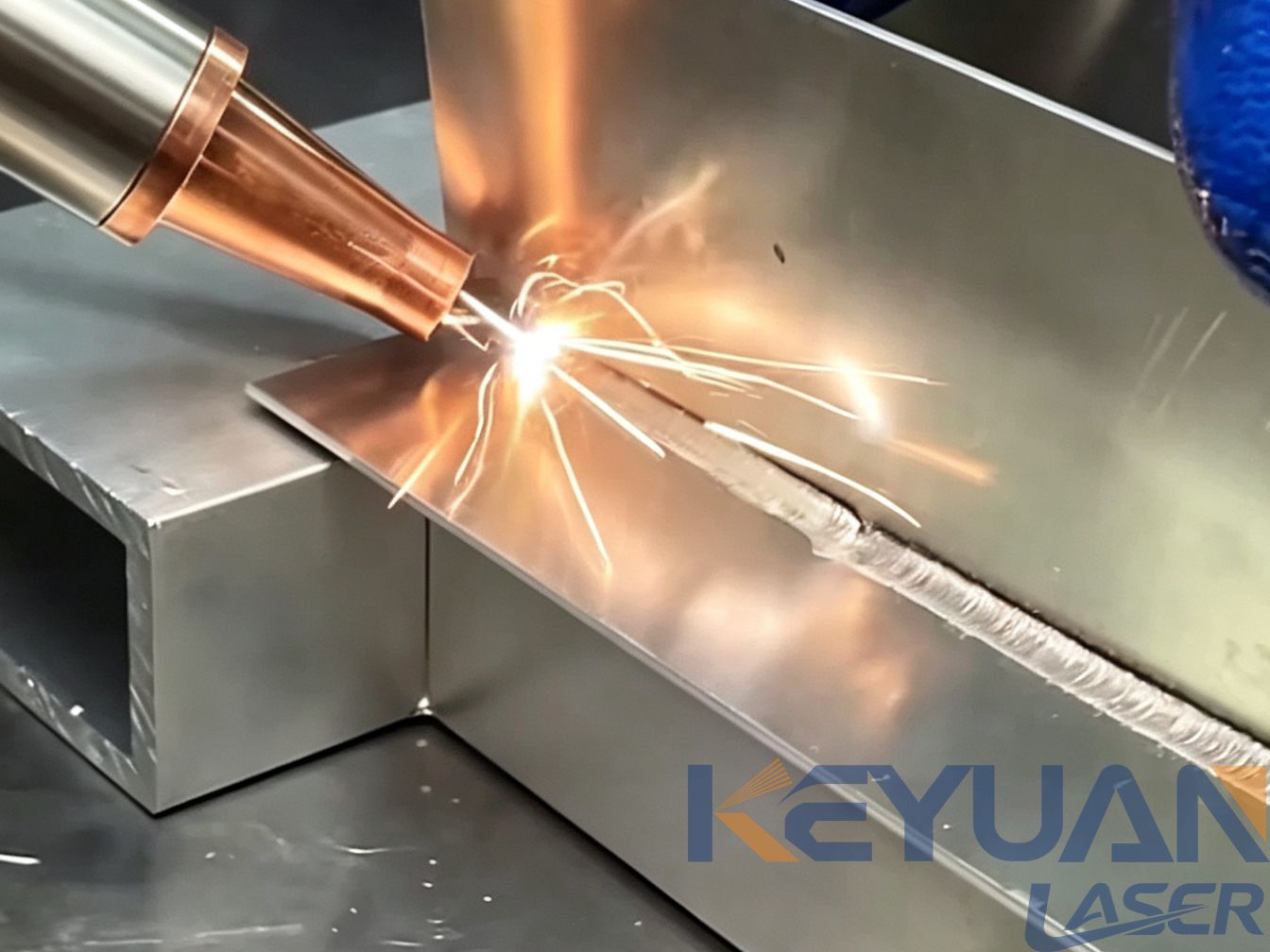
Those penetration figures assume argon shielding, a near-zero fit-up gap and a wobble gun. Change any one of the three and your real numbers move, which is why buying on wattage alone is the most expensive mistake in this category.
The rule we give most buyers: pick the lowest power that covers your thickest routine joint, then spend the leftover budget on a better gun and a better laser source. A 1500 W machine with a wobble gun welds 2 mm stainless faster and cleaner than a 2000 W machine with a fixed spot head, and it costs less to run. What nobody mentions at the quotation stage is that once you pass 1500 W the single-phase supply usually disappears, and the electrical work can add more to the project than the power upgrade itself.
Laser Source: Same Wattage, Different Machine
Two fiber laser welding machine models rated at 1500 W can behave quite differently on the same joint, depending on which source sits inside the cabinet. The names that turn up most in export machines are Raycus, Maxphotonics, JPT, BWT and IPG. The price spread between them is real, and it buys three things.
Beam quality. A tighter beam cuts a deeper, narrower weld at the same power, and the difference is easiest to see at 3 mm and above.
Power stability under duty cycle. Some sources droop as they heat, so part fifty does not match part one.
Service network. When a source fails, how many weeks until a replacement lands in your country?
Ask for the source brand and model number in writing, not just the wattage on the crate. In our experience a source swap is the fastest way a supplier cuts cost without changing anything a buyer can see.
The Welding Gun Decides Your Day
This is the spec buyers underweight most, and then feel on every shift.
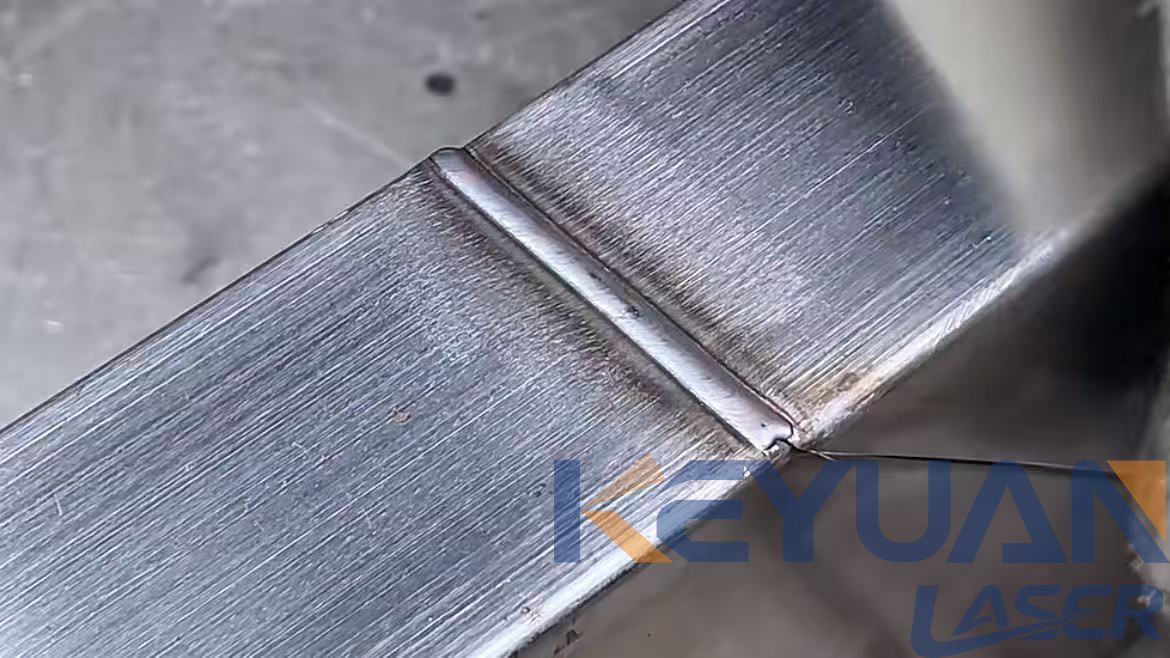
Fixed spot gun. A narrow beam that demands tight fit-up. Gaps above roughly 0.2 mm show up as incomplete fusion, and no amount of extra power hides them.
Wobble (oscillating) gun. The beam sweeps across the joint and widens the melt pool. It tolerates fit-up gaps up to about 0.5 mm, produces a smoother bead, and runs markedly better on thin sheet because the heat is spread over a wider area.
Weight matters as much as optics. An 0.8 kg gun and a 1.6 kg gun are the same job for the first hour and a different job by the eighth, and operators will tell you that on day one. Check the price and lead time of the protective lens while you are at it, because it is a consumable: a machine that eats a lens a week is not a cheap machine.
Cooling: Water, Air and Duty Cycle
Water-cooled machines hold a stable duty cycle and suit bench and production work, but they need a chiller, and the chiller needs coolant changes, filter cleaning and floor space that a small shop may not have. An air cooled laser welder drops the chiller entirely, which is what makes it the realistic option for on-site repair where there is no water supply and no room for a separate unit. The air cooling welder with a built-in nitrogen generator is the configuration most of our repair customers settle on, because it takes the gas bottle off the truck as well.
The trade-off is duty cycle, so confirm the continuous rating rather than the peak figure. Sixty percent duty at 30 degrees ambient is a different machine from the same model working at 45 degrees in a summer workshop, and nobody quotes the second number. If you weld eight-hour shifts rather than intermittent repair work, water cooling is usually the cheaper answer over five years.
Shielding Gas: Argon or Nitrogen
| Gas | Behaviour | When to use it |
|---|---|---|
| Argon | Cleaner, brighter stainless bead, better arc stability | Stainless steel and visible cosmetic welds |
| Nitrogen | Lower cost, but can cause porosity in stainless | Some carbon steels where cost dominates |
Set flow around 15 to 25 L/min, and set pre-flow and post-flow separately rather than leaving the factory defaults. A short post-flow is one of the most common causes of a discoloured, oxidised bead, and extending it by one or two seconds fixes the problem outright in most cases.
Flow matters in both directions. Too much gas creates turbulence that drags air into the melt pool, which is why the table below lists both a low and a high flow as causes of the same defect. Nitrogen costs less per bottle, which is why it keeps appearing in quotations for carbon steel work, but on 300-series stainless it is a porosity risk you do not need to take.
Fiber Length, Site Power and Installation
Standard fiber options run 5 m, 10 m, 15 m and 20 m. A longer cable means more optical attenuation and more cable to manage, and if it will not reach your largest workpiece, every job becomes a repositioning exercise with a forklift. Measure your biggest part before you order, not after the container lands.
Site power is the most common installation surprise for overseas buyers. A 1500 W unit may run happily on single-phase 220 V, while a 2000 W or 3000 W machine may need three-phase 380 V, and plenty of older buildings do not have the spare capacity. Confirm the requirement in writing and check it against your actual supply before the machine ships. Ask about ambient temperature derating and ventilation for the room it will live in as well, because a welding cell with the doors closed heats up faster than the datasheet expects. Photograph your distribution board and send it with the enquiry; it saves a week of back-and-forth.
Common Weld Defects and What Causes Them
| Defect | Usual cause | Fix |
|---|---|---|
| Porosity | Gas flow too low or too high, contaminated surface, nitrogen on stainless | Set 18 to 20 L/min, clean with acetone, switch to argon |
| Spatter | Power too high for the thickness, focus off the joint, fixed-spot gun | Reduce power by about 10 percent, correct focus, enable wobble |
| Lack of penetration | Power too low or travel speed too fast | Increase power or slow the travel |
| Burn-through on thin sheet | Too much power, zero gap, no oscillation | Lower power, add a small gap, widen the wobble |
| Discolouration and oxidation | Insufficient shielding, post-flow too short | Extend post-flow by 1 to 2 s, check nozzle angle |
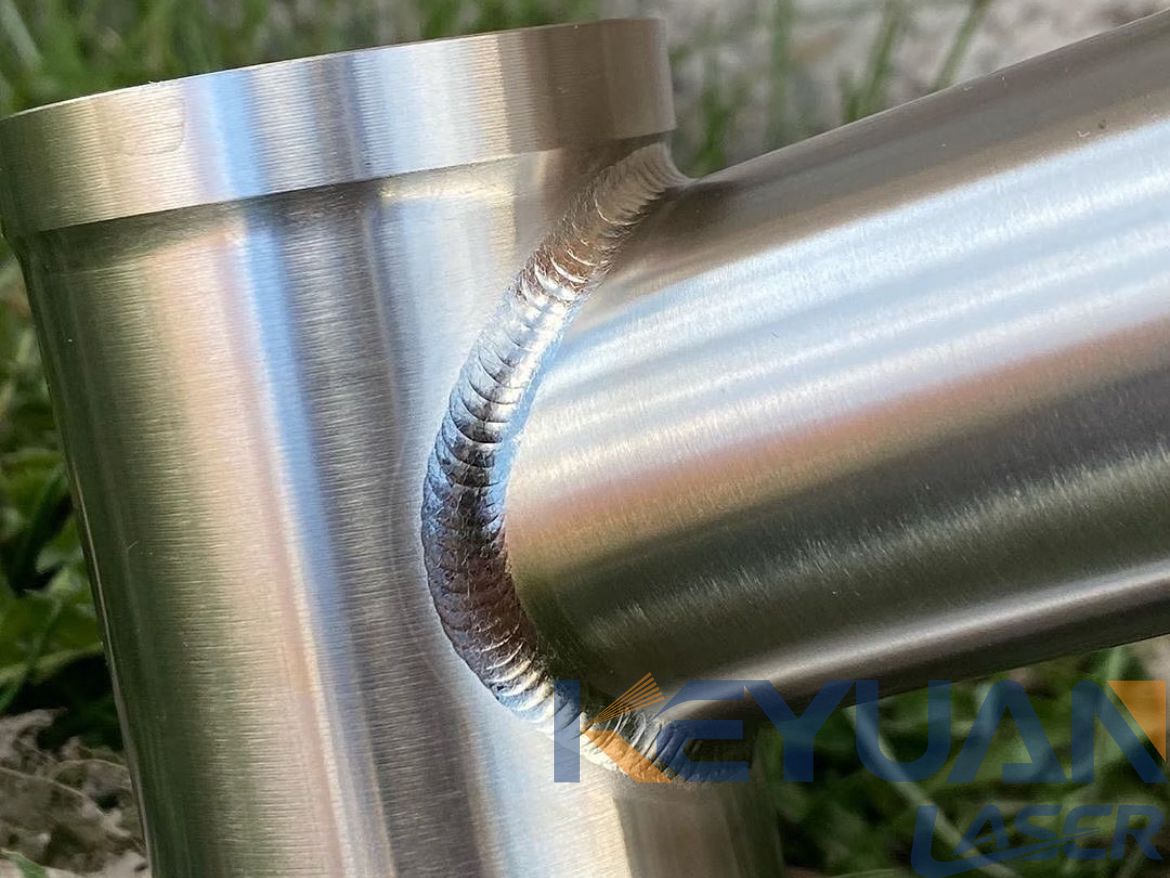
For thin material specifically, thin stainless cabinet seam welding is a useful reference for how much the wobble setting changes the result, and it is worth reading before you accept a default parameter set. If your workflow also covers surface preparation, a pulsed laser cleaning machine lifts rust, mill scale and oxide without abrasives or solvents, which removes one of the porosity causes in the table above.
Most of the defects in that table are process problems rather than machine problems. The exception is the last row: a bead that suddenly cannot be tuned is often a failing protective lens, and that is a consumable, not a setting.
FAQ
Can a handheld laser welder weld aluminium?
Yes, with the right settings. Aluminium reflects more of the beam and conducts heat away from the weld quickly, so it needs higher power, a wobble gun and careful gas coverage. Run a sample on your own alloy and thickness before committing to a production setup, because 5052 and 6061 do not behave the same way.
Is 1500 W or 2000 W the better choice?
For most sheet metal work between 0.5 and 3 mm, 1500 W covers the job and costs less to buy and to run. Step up to 2000 W if you routinely weld 3 to 4 mm, or if travel speed is the constraint on your line.
Do I need argon or nitrogen shielding gas?
Argon for stainless and for any weld where appearance matters. Nitrogen is a cost option for some carbon steels, but it risks porosity in stainless, so treat it as a process decision rather than a price decision.
How thick can a handheld laser welder weld in one pass?
Roughly 2 to 3 mm at 1500 W and 3 to 4 mm at 2000 W, assuming argon, tight fit-up and a wobble gun. Thicker joints go in multiple passes, or with filler wire.
Can it weld with filler wire?
Yes. Most handheld systems accept a wire feeder running 0.8 mm, 1.0 mm or 1.2 mm wire, which widens the useful thickness range and helps bridge gaps where fit-up is poor. Wire feed also changes the gas requirement slightly, so re-check flow when you add it.
What to Check Before You Buy
Ask for a weld sample on your material, at your thickness, with the gas you intend to run.
Get the laser source brand and model number in writing.
Get the protective lens price and delivery lead time in writing.
Confirm the power supply requirement against your building, not against the brochure.
Confirm who services the unit locally and where the spare parts sit.
The fastest way to choose is to weld your own part. Send us the material, the thickness and the joint type, and we will run a sample, photograph the bead and come back with a configuration that fits the work.
label:
related news


E-mail address:
Hotline:
Copyright © 2012-2026 Keyuan Laser All rights reserved